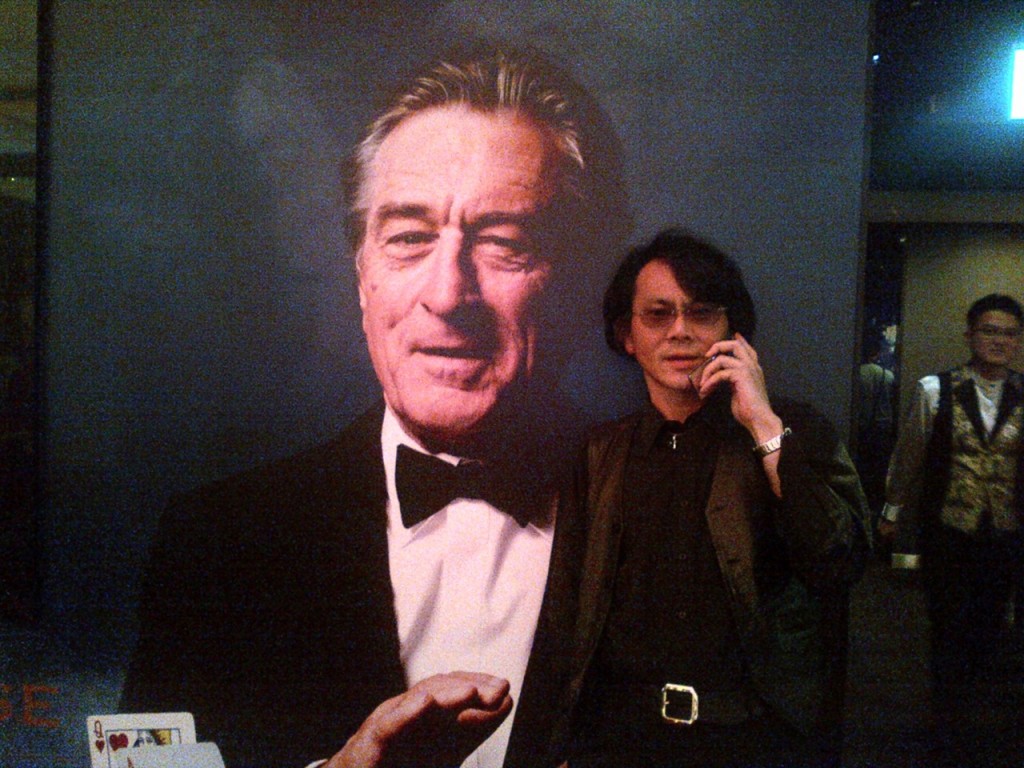
Android robot legend Hiroshi Ishiguro and Robert De Niro
posted in: Uncategorized


In the Ogilvy FUEL conference there was a brilliant talk by Tam Khai Meng called Global Dreams where he showed very creative works in advertising worldwide. What I was amazed is many brilliant works from places I never think of for creativity such as Africa and South America.
At the end of the talk he showed a latest work which showed neurons have been found in the human heart. His point was to follow the human heart. But for me it was exciting further evidence that thinking and mind is a deep connection between brain and mind and that we need to trigger all of our senses for effective creativity and learning.
Today I had the chance to have a deep discussion with Rory Sutherland who is Vice Chairman of Ogilvy about logic and creativity. He gave an excellent talk about behavioural economics at the Ögilvy FUEL event. In his talk he gave many examples of how logic is placed at highest priority in our society but in the real world logic can only answer a small subset of problems and creativity is required to find solutions. As an engineer I wanted to find out what he thought we could solve by logic. Since engineers are taught in logic. After a long discussion it seems that problems that fall under the category of newtonian physics can be solved by logic. But almost all problems in life involve non linearity and humans and therefore we need a combination of creativity and logic. A good example is someone turning the screw on your airplane wheels. We don’t need (or want) creativity in that case because it has a well proven logical solution, and following that logic is required for the system to work (and not crash the plane). But even in this case creativity should be applied at a META level. For example, maybe some other way of turning the screw is more efficient. But for most systems which are non newtonian and involve humans we need creativity. For example the air France crash where a logical control design didn’t take into account an opposite control signal to logical controller and the plane crashed. Or something simple like the problem that a school had that the corridors were too crowded. The logic solution will analyze increase corridor width etc. The creative solution is to stagger class times so all the students are not walking at the same time.
Rory recommended to read the Nobel Prize winning acceptance speech on The limits of information. It is at this link http://www.nobelprize.org/nobel_prizes/economics/laureates/1974/hayek-lecture.html
Rory said actually engineers are very good at understanding the limits of information. Because we have to deal with complex and human systems (although I think a lot of academic engineering ignores this and is in its own unreal world). He said the worst is finance people who want to reduce everything to numbers.
I was deeply impressed with the brilliant mind of Rory Sutherland. It really impacts the way I will look at the world.
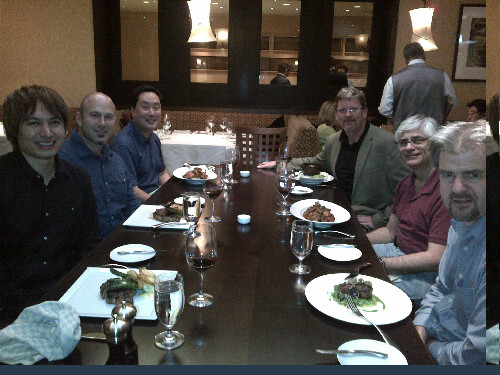
Augmented Reality Gurus. I had the pleasure to have dinner with my good friends and gurus of augmented reality, Mark Billinghurst, Ron Azuma, Steven Feiner, amongst others. What I remembered was a similar dinner about 10 years ago in los Angeles at a SIGGRAPH. I noticed we are all grayer and fatter (of course me included). However one thing was the same. We were all like youngsters with our “geeky” discussions on technology and augmented reality. Steven Feiner showed a new AR glass he is making in the lab. We talked about how the cardboard was etched using a 3D printer. Mark told me about his new app which you can view the heritage buildings in Christchurch. I talked about tasting your food digitally. Yet somehow I felt no technology could ever replace such a real world dinner with old friends.
Ogilvy is one of the world’s largest advertising companies in the world. It is a truly global company. For the first time in seven years they are having an internal conference for their top global executives and it is in Kyoto. About 4 or 5 people have been asked to come to give talks and workshops. I have been asked to give an Innovation workshop. I will give it four times in a row. My plan is to give a short talk on methods to be creative, and then we will do a short workshop in groups. I have set up a workshop which is based on imagining you are a ninja from 17th century transported to 21st century. Using only materials available in 17th century you have to find a creative solution to recovering an ancient scroll from the Kyoto national museum. Then as a group we will story tell our idea and invention. The main message is to be creative use all parts of your senses and brain. Think, sketch, draw, make, communicate, and iterate.
So it is mainly Ogilvy company executives, and it is very interesting to be part of this company event. The conference is very powerful, at the opening, CEO Paul Heath said the aim is for the company staff to be the best in the whole world. That vision is really inspiring and that is the kind of vision I always want to be part of. Ogilvy is all about creativity. They want to be the best storytellers, natural collaborators, and to be effective in delivery. I agree with this. Innovation is about creative ideas. But without collaborating and making a real world output, it is simple an idea. We need to turn creative ideas into reality.
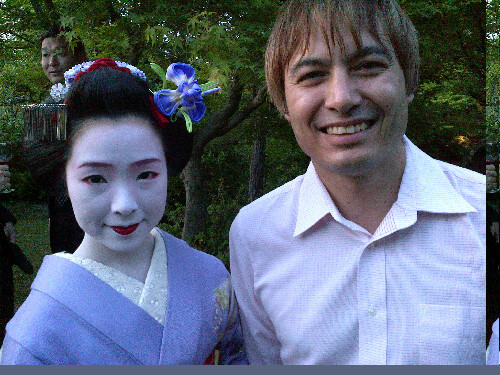
Adrian David Cheok to speak at Seoul Digital Forum 2012
Mixed Reality: Beyond the Real-Virtual Dichotomy, Expanding Human Potentials 2012-05-23
The scope and reach of human influence is being extended. The new generation of mixed reality technologies is merging the real and the virtual, making possible simultaneous interactions between the two worlds. With its limitations in interface design and accessibility being mitigated, mixed reality is making tangible contributions to expanding the human potential in an increasing number of practical fields including healthcare, education, training and media by lowering spatiotemporal barriers. With the real and the virtual coming to coexist and be increasingly interfused, what kinds of benefits and obstacles lie in store for us?
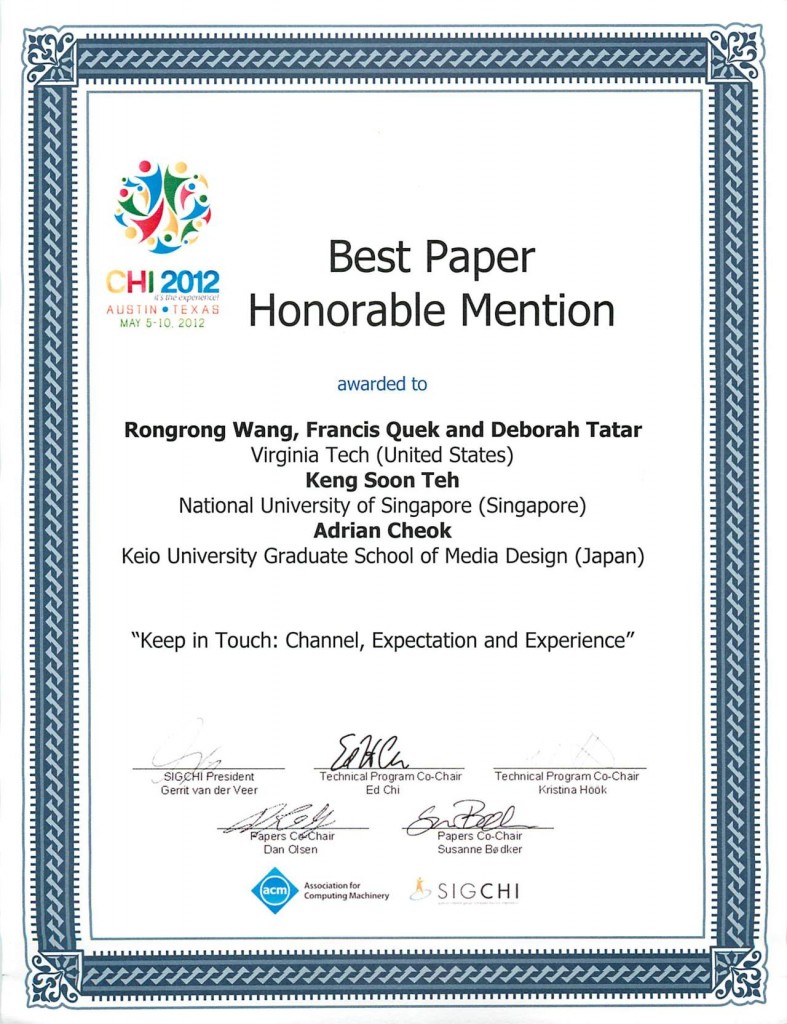
Award at CHI 2012 for our paper “Keep in Touch: Channel, Expectation and Experience”. It is the academic paper for the Huggy Pajama project.
Human-Computer Confluence VISIONS Powerpoint presentation download
I was recently invited to give a talk at a workshop for an EU project called Human-Computer Confluence. It was a small group of about 15 scientists discussing the future of the merging of humans and computers and preparing for a future European Union project. You can download my powerpoint presentation and view if you wish.
Human-Computer Confluence Research Challenges
HCI research over three decades has shaped a wide spanning research area at the boundaries of computer science and behavioral science, with an impressive outreach to how humankind is experiencing information and communication technologies in literally every breath of an individuals life.
The explosive growth of networks and communications, and at the same time radical miniaturization of ICT electronics have reversed the principles of human computer interaction. Up until now considered as the interaction concerns when humans approach ICT systems, more recent observations see systems approaching humans at the same time. Humans and ICT Systems apparently approach each other confluently.
Human Computer Confluence has been mentioned to become a research priority in “Horizon 2020″ (2013-2020), the funding programme of the European Commission that follows after the 7th Framework Programme (FP7, 2007-2013). HC2 VISIONS is a research agenda solicitation action (FP7 FET Project HC2) which may or may not be influential to the FET work programme discussion on new directions in human computer confluence. The HC2 VISIONS workshop invites key experts to pose initial research challenge statements articulated by the scientific community in a crowd sourced solicitation attempt. The goals of the workshop are to shape research challenge statements indicating (i) vision, (ii) research approach and (iii) expected impact of prospective research issues by world leading experts in the field. HC2 VISIONS is accompanied by a web-based white-book initiative at www.pervasive.jku.at/hccvisions.
Evan Esar
In Wickedictionary