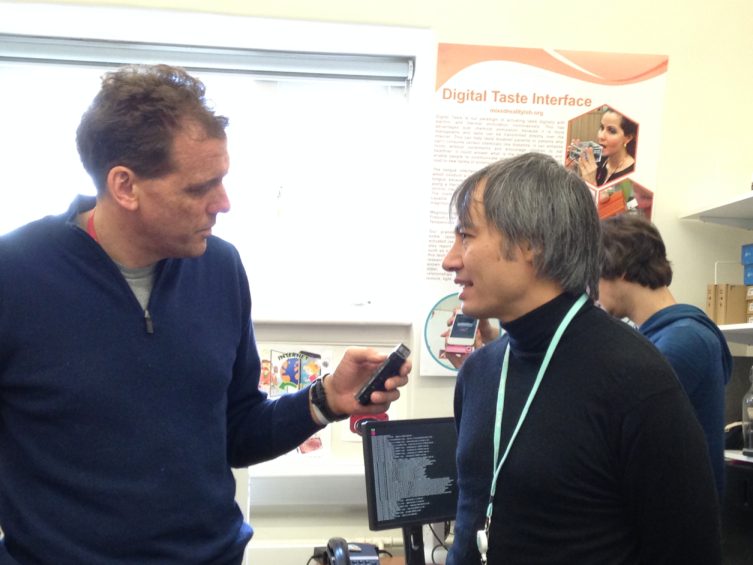



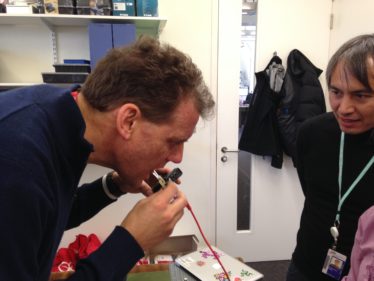
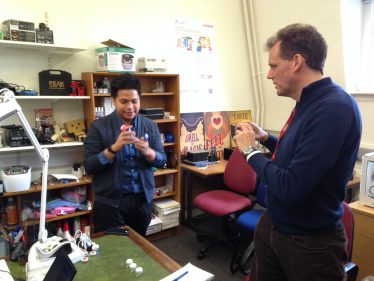

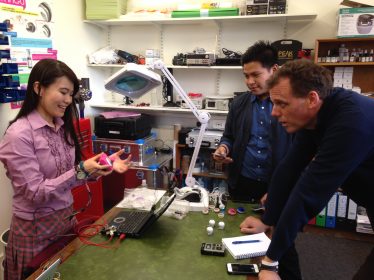

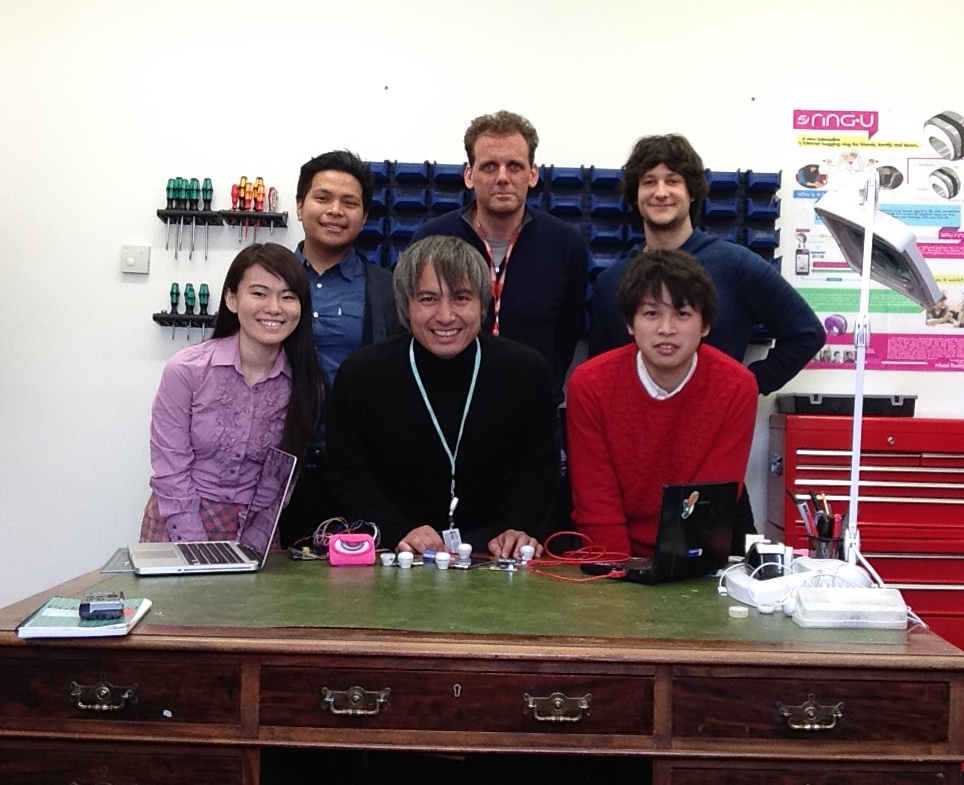
BBC Radio 5 presenter Stephen Chittenden had a live interview with Professor Adrian Cheok and his students in his lab in London.


BBC Radio 5 presenter Stephen Chittenden had a live interview with Professor Adrian Cheok and his students in his lab in London.

WRITTEN BY A.V. FLOX

David Levy and Adrian David Cheok, founders of the annual Congress on Love and Sex with Robots, assert we’re very close now to creating a sex robot, going as far as to say that such robots will be normalized by 2050. If recent press cycles are any indication, most of us believe this.
But we’re wrong.
That we have made immense progress in a number of disciplines that directly relate to the development of humanoid robots is not in dispute. Over the past few weeks, one of Google’s artificial neural networks has shown that by using reinforcement learning it could best the world champion of Go, an abstract game that is harder than chess. This type of learning-on-the-go has serious implications for robots, which have difficulty negotiating new terrains, objects and situations.
Likewise, developments in the molding of polymers are revolutionizing the field of soft robotics, allowing robots to better physically deal with real-world dynamic environments and handle objects that fall outside their programming parameters. We’ve even created thin polymer films with built-in sensors that sense pressure and heat, not unlike skin.
But we’re wrong to think that these and so many other other advances will coalesce as easily as people seem to imagine to create a commercially-available, self-aware, humanoid sex robot.
The self-aware humanoid we imagine when we think of a sex robot will need a variety of sensors to have an awareness of its environment. It will need to have a sophisticated artificial intelligence. It will need machine learning to respond to changes and negotiate situations outside its programing. It will need natural-language processing. To overcome the uncanny valley, its movements and expressions will have to be matched to human expectation. Its skin will require nanotechnology to replicate the lifelike lack of uniformity of human flesh, and its eyes will require a different nanotechnology to simulate the wetness of our own.
Sex robots are going to require multiple disciplines to come together because they’re not simply mechanized sleeves or dildos. Unlike a haptic dildo or robotic sleeve, sex robots are not going to be simple enough for a single genius to put together on their own.
But if the hurdles facing haptic dildos, robotic sleeves and other creations within the nascent sextech industry are any indication, we are never going to get to the sex robots at all.
Andrew Quitmeyer, cofounder of the sextech startup Comingle, had no idea he was being sued when he responded to an unsolicited message from an attorney asking if Comingle already had legal representation.
“I was like, ‘LOL, representation for what?'” he told me over the phone. That’s when he learned that a firm by the name of TZU Technologies had filed a lawsuit against his startup for infringing on a patent held by TZU.
Comingle, like most sextech startups, was a small operation. Knowing that every human body is different, the company was building an open-source platform to help users hack its sex toys so that any user would be able to modify vibration patterns to suit their preferences.
Comingle had been lucky. Harnessing the power of social media, the startup had managed to use crowdfunding to get around the problem of financing that plagues so many companies in sextech.
It’s an unfortunate reality that many sextech companies find it difficult to get small business loans due to morality clauses and banks’ concerns over “reputational risk.” And investors too are wary of sextech. Quitmeyer has lost count of the number of times he was invited to show investors a deck, only to be told afterward that while Comingle’s work is great, investors simply don’t fund things that fall under the category of “sex, drugs, and rock ‘n’ roll.”
“The amount of publicity that we’ve been able to gain at Comingle—if we were any other Silicon Valley startup, we’d already be in our A-round of funding upwards of millions of dollars,” Quitmeyer said.
“We’ve been kicked out of two accelerators!” he added. “We passed all their hoops and training and customer discovery and at the end, when they’re supposed to give you space and funding and support, they came back and said, ‘we checked with the higher-ups and turns out we’re not comfortable dealing with sex stuff. Goodbye.’ Months lost.”
It’s not all puritanism: in a country where sex is so politicized, investors are right to worry about the impact of future government regulation. Something as simple as limiting the online purchase of adult technology to credit cards—as opposed to also allowing debit cards which might enable minors to have access to these products—could dramatically impact a product’s likelihood of success, since not all adults have credit cards or want to use them for such purchases.
Sextech companies also face restriction from other companies: Google and Apple, for example, grudgingly allow sex-related health apps, but their acceptance of sextech that exists solely for pleasure and titillation has so far been spotty. Would Play or the App Store let you gear up your sexbot as you begin your commute home from work in the same way they let you do with your Nest? Their track record doesn’t bode well for sexbots.
This turns off investors, too. Sean Percival, a venture partner with the seed investor firm 500 Startups in Mountain View, told me that being barred by such key distribution channels is a serious handicap for a company.
“Getting rejected [by a main distribution channel like Play or the App Store] would make it difficult for you to scale,” Percival said.
Like most people, Percival was only vaguely aware of the existence third-party app stores that cater to adult apps. But even MiKandi, the best known Android third-party store for adult apps, only has 5 million users—a tiny fraction compared to Google’s Play Store, which reported a billion users last year.
The situation makes investment dicey, disadvantaging sextech.
The result is a thinly populated landscape of bootstrapped outliers, which have miraculously managed to get by on sheer determination. Their efforts have been modest: robotic masturbator sleeves and dildos, an upgrade to the type of motor used in vibrators, a variety (some quite sophisticated) of erotic electrostimulation devices, life-size humanoid sex dolls (some with mechanized heads), virtual reality porn, and teledildonic devices.
But funding is difficult to come by, and after factoring in all the costs of bringing a product to market and running the day-to-day operations of business, there’s little left over for the research and development required to take the industry to the next level, and certainly not to enable them to start the work needed to bring sexbots into being.
And this is all before a sextech company is targeted by a patent troll.
A patent troll is generally a business that makes most of its money by buying patents and getting companies that infringe on them to pay a licensing fee. In the US, inventors who file for patents are given exclusive rights to their inventions for 20 years, a monopoly meant to enable them to recoup the cost of developing their invention.
This makes sense in theory. For example, a pharmaceutical company that spends years developing a vaccine would have no reason to make the hefty investment required for that research without the protection of a monopoly. At the same time, by disclosing its invention to the state and allowing it to eventually go into the public domain, the risk of losing that knowledge is minimized.
But the system isn’t perfect, and its flaws have allowed patent trolls and frivolous lawsuits to proliferate. In 2011, it was estimated that patent litigation cost the tech industry $29 billion in legal and licensing fees. That figure has been on the rise: it was $6.7 billion in 2005 and $12.6 billion in 2008. With total spending on research and development in the United States at $247 billion, some have argued that patent infringement lawsuits have in effect levied a 10 percent tax on innovation. But this is only true when patent trolls go after big companies. When they go after small ones, they often sink a company.
The Real Touch is a perfect example of the chilling effect of patent trolls on sextech innovation. The North Carolina-based teledildonics company Real Touch made a splash in 2009 with a sleeve that plugged into a computer via USB and transmitted sensations based on scenes of a viewer’s choosing. The sleeve didn’t only squeeze: it simulated heat, wetness, friction and intensity, all of which were coded differently depending on whether the scene being watched featured vaginal sex, anal sex, oral sex, manual sex, and so on.
Real Touch was our first serious step toward the pleasures we imagine when we think of sex robots, and at $200, it wasn’t completely inaccessible in terms of price. Yet by 2013—and despite being featured on HBO’s Sex/Now and Amazon’s Betas—Real Touch was no longer manufacturing new units. The revenue from sales could not keep up with licensing demands made by patent trolls.
It says something that despite not having sold any new devices since 2014, Real Touch’s parent company, Internet Services LLC, was nevertheless named in the lawsuit by TZU that also targeted Comingle in June of last year.
This lawsuit is over the infringement of a patent for “a stimulation device receiving the control signal from a user interface.”
If that patent seems overly broad, you have identified the main problem with our country’s patent system. As the software industry has been saying for decades, the main cause of frivolous patent lawsuits falls squarely on the shoulders of the United States Patent and Trademark Office (USPTO).
“Patents are too easily issued right now,” said Carter Laren, a Bay Area-investor and director at the startup launchpad Founder Institute. “You get lots of junk patents issued that are obvious or even though there is prior art [evidence that an invention is already known] and they should never have been issued.”
Laren is rare among investors in that he was willing to fund a sextech startup. Almost ten years ago, he put his money on OhMiBod, a small New Hampshire company that makes a line of vibrators that can be operated via wifi or Bluetooth. (Since its launch in 2006, OhMiBod has raised $750,000. Compare that to TechCrunch’s 2013 figure of$41 million raised for the average successful startup.)
When OhMiBod started to draw serious media attention, the startup was immediately targeted by a patent troll.
“It was some guy who hadn’t produced anything, had written a patent that was something about combining audio signals with vibrations,” Laren recalled. “I did some internet research—there was prior art for his patent. What he was claiming easily could have been knocked out in court. Our lawyers agreed that in court we would win. But they said, ‘this is what it’s going to cost you in court. It’s probably just worth settling.'”
An invention must be new, useful, and nonobvious to qualify for a patent. But if patent examiners at the USPTO aren’t well-versed in advances in a certain sector (and they usually aren’t), things that are known within an industry can appear nonobvious to them, resulting in the issue of junk patents that are used to squeeze money out of innovators instead of protecting legitimate inventions.
“Very rarely do you end up with any patent examiner who understands the patents, actually really understands any of the prior art, and pushes as much as he or she should,” Laren said. “The whole thing is kind of just a joke. If you’ve ever gone to the Patent Office, it’s like going through the motions. I think a large percentage of patents that get issued, I would classify as obvious.”
The sextech space is having a junk patent frenzy not unlike that which has chilled innovation in the software space. There’s big money to be made in getting a junk patent filed and going after settlements from anyone who infringes.
Quitmeyer thinks these egregious patent tactics have an even easier time getting by in sextech because of the stigma of sex.
“Once you have the word sex in it, it appears that the Patent Office gets a little freaked out or something and they just let anything pass,” he told me. “Someone applies to the Patent Office, and they’re like, ‘Hey! I have an idea! Here’s a thing with more than one vibrating motor. Isn’t that crazy? Most things have one motor, what if we have two?’ When you start looking at these patents, it gets freaky and scary [seeing what has managed to get a patent].”
The example he gives may sound hyperbolic, but it isn’t. The company Wing Pow filed a patent in 2009 for a “massage device with a plurality of vibrators.” It was awarded. Wing Pow also holds a patent for a “mechanized dildo” that isn’t even a vague improvement over the Pearl Rabbit, a vibrator that was already well known to America when the Wing Pow patent was filed in 2008, having made an appearance a whole decade earlier on an episode on the HBO show Sex and the City.
Patent trolls are not unaware that a number of the patents that they acquire and enforce are dubious. They rely on the high cost of launching a legal defense to cow companies into paying speedy settlements.
“The idea of issuing the patent is, well, you can go win in a court case and show the prior art and show that it was obvious and throw the patent out,” said Laren. “That’s true, but that costs money. So you end up in a shakedown situation. Anyone can come in and harass you with a shitty, crappy patent, and you have to pay them off to go away.”
The cost of defending a patent in court can easily run into the six figures. In 2011, aBoston University study in 2012 found that small- and medium-sized companies, like those that dominate the sextech space, spend $420,000 to litigate a patent dispute on average, with the median at $70,000. Two separate studies, that from Boston University and another from Santa Clara University School of Law, determined that over half of patent troll lawsuits targeted small and medium companies with a median revenue of $10 million.
By going after small companies that don’t have the resources to wage a costly legal battle, patent trolls are almost guaranteed a speedy settlement. An analysis in 2013indicated that while patent trolls filed 67 percent of all new patent infringement cases (up from 28 percent in 2008), only 20 percent of decisions involved them, illustrating the general tendency for such cases to settle. These settlements add up, enabling patent trolls to go after bigger, more lucrative targets.
Laren is glad OhMiBod settled.
“You’re not just paying lawyers,” Laren explained. “When you’re a small business, that distraction costs you. You gotta spend your time and energy dealing with this instead of growing the business, and that has a real impact. When we looked at everything, it was clearly going to cost in the six figures, and it was easier to just pay this guy off than it was to keep moving forward and fight him even though we knew were going to win.”
Julie Samuels, the president of Engine, a San Francisco-based nonprofit that advocates on behalf of tech startups, reiterates this. Speaking to Vice News, shenoted, “What we’ve seen, particularly in the software space, is that patents aren’t incentivizing innovation. Instead, they’re having a chilling effect because no one wants to be sued.”
Patent trolls demand a median of $180,000 as a licensing fee to make their lawsuits go away. Quitmeyer describes the six-figure pay-off as the “sweet spot.”
This “sweet spot” is what TZU Technologies was after when they came for Comingle. As mentioned earlier, the patent held by TZU is so vague, TZU could easily threaten legal action against any technology company that relays a command from a processor to a device that vibrates. The reason TZU doesn’t do that is that the patent is so dubious that any company with the money to take the company on would win, so like most trolls, TZU focuses on small outfits that can’t afford the fight.
(In a moment of incredible hubris last year, TZU sued Kickstarter for enabling the violation of its patent by allowing infringing companies to use the crowdfunding platform to raise money, but it quickly dropped the case when the well-positioned Kickstarter decided to take the case to court.)
“[The TZU patent] is being asserted against anyone who does any sort of sex toy that uses a network or a wireless communication device to operate a sexual device,” said Franklin Veaux, winner of last year’s highest award in sextech, Arse Elektronika’s Golden Kleene. “So for example, anyone using Bluetooth, anyone making an internet-controlled toy, even people using wireless remotes are getting hit by this patent troll.”
Veaux is trying to help Comingle and other targets of TZU get together the necessary prior art to kill the patent once and for all. Veaux himself developed a prototype for a teledildonics device called the Symphony using the technology TZU’s patent covers—three years before the patent was filed.
“The patent troll uses essentially mob-style tactics,” Quitmeyer told me. He recalled talking to TZU’s attorneys: “They looked at us and said, ‘hey, we can make this all go away. Just let us know how much money you have.’ I get phone calls in the middle of the night—which I assume are scare tactics—from anonymous numbers where people will leave me phone messages that say stuff like, ‘hey, Andy, I hear that you don’t like patents. Well, sometimes you just have to play by the rules. I’ll see you soon.’ Isn’t that insane?”
Comingle didn’t have the money to pay off the trolls, much less to fight a costly legal battle. The cofounders were about to close up shop when the Electronic Frontier Foundation got them in touch with a lawyer willing to fight their case pro bono.
But since being sued by TZU last summer, Comingle continued to receive additional cease and desist letters relating to other patents, among them from the aforementioned junk patent bully Wing Pow.
“When we get a cease and desist letter, we have to go to a lawyer—and even with a discounted lawyer who likes our cause, writing a letter for us to get [patent trolls] to back off still costs $700 or $800,” Quitmeyer lamented. “It’s just a nonstop feeding frenzy with these guys.”
Last month, with the case against TZU still ongoing and after a barrage of cease and desist letters, Comingle’s cofounders finally made the decision to cancel their project.
This week’s podcast brings you two stories about how humans interact with artificial intelligence. Radio Motherboard is available on iTunes and all podcast apps.
“This terrible case [against TZU], (that’s still going), feels like it will never disappear, and this sort of bullshit can take not only massive financial tolls, but extremely mental tolls as well,” they wrote on a post announcing the decision. “It’s difficult to keep working non-stop, every day, when there is a huge thing like an international lawsuit looming over you.”
Stories like those of Comingle and Real Touch are significant because sex robots are not simply mechanized sleeves or dildos. They’re not going to be simple enough for a single genius to put together like she might a haptic sex toy or a chat bot. They’re going to need a lot of tech, and that means patents.
Look at your smartphone. That sleek little machine that fits into your pocket contains some 250,000 different patented components. How many do you think will make up the robots we have in mind? Only one thing is certain: licensing will be steep. This means serious investment, and given the current attitudes toward sex-related products in this country that is not likely.
Source: https://motherboard.vice.com/read/comingle-sex-robots-congress-coming-is-a-pun
Young Global Leaders Interview at WEF Davos in Tianjin

Adrian David Cheok is featured on a TV documentary series, Tegenlicht, aired in the Netherlands.
http://tegenlicht.vpro.nl/afleveringen/2015-2016/tinder-love.html
The Future of Our Digital Senses
Adrian David Cheok is currently Professor of Pervasive Computing at City University London and the Founder and Director of the Mixed Reality Lab, Singapore. A gifted inventor, academic and speaker, with an impressive research pedigree; his work ranges across wearable computers, ubiquitous computing and pervasive and virtual computer realities.
For Cheok, nothing less than “the next level of the Internet” will suffice. He wants to create a sensing symbiosis – between humans and machines and the analog and digital world. He is striving to form a new sensory vocabulary, that redefines what we experience. If he is successful, the way we perceive our world and the way we sense our reality may be altered drastically forever.
© 2016 Hypernetec Ltd
Recorded at the Wearable Technology Show 2015.
In today’s fast-paced world, financial literacy has become a crucial life skill. However, many individuals, especially young people, lack the foundational knowledge needed to manage their finances effectively. This gap can lead to poor financial decisions and long-term economic struggles.
Financial literacy clubs offer a practical solution by providing a supportive environment where students and community members can learn essential money management skills. These clubs empower participants to make informed financial decisions, setting them up for success in both their personal and professional lives.
The Importance of Early Financial Education
Financial habits form early in life. By introducing financial education in schools and communities, we can equip individuals with the tools they need to navigate financial challenges confidently.
1. Building a Strong Financial Foundation
Teaching students about budgeting, saving, and investing lays the groundwork for financial stability. When young people understand the value of money and how to manage it, they are better prepared to handle real-world financial responsibilities.
2. Preventing Financial Missteps
Early financial education helps individuals avoid common pitfalls such as excessive debt, poor credit management, and lack of savings. With the right knowledge, they can make smarter choices and build a secure financial future.
3. Closing the Financial Literacy Gap
Many adults struggle with basic financial concepts due to a lack of early education. Financial literacy clubs address this gap, fostering a culture of informed decision-making across all age groups.
Activities and Resources for Running a Successful Club
To ensure the success of a financial literacy club, it’s essential to offer engaging activities and accessible resources that cater to the needs of participants.
1. Interactive Workshops
Workshops on topics such as budgeting, credit management, and investment strategies can make financial concepts more relatable. Interactive sessions encourage participants to apply what they’ve learned to real-life scenarios.
2. Guest Speakers and Mentors
Inviting financial professionals—such as bankers, financial advisors, or entrepreneurs—provides participants with valuable insights and practical advice. Mentorship opportunities can also offer personalized guidance and inspire confidence.
3. Hands-On Projects
Activities like creating a personal budget, developing a savings plan, or running a mock investment portfolio help participants gain practical experience. These projects reinforce key concepts and make learning more engaging.
4. Access to Financial Tools and Resources
Providing access to budgeting apps, financial calculators, and educational materials ensures that members can continue learning outside of club meetings. Resources such as online courses and e-books can further enhance their understanding.
5. Community Engagement
Organizing events like financial literacy fairs or community workshops helps spread awareness and extends the club’s impact beyond its core members.
Real-World Impact Stories
The true power of financial literacy clubs lies in their ability to transform lives. Here are a few inspiring examples of how these clubs have made a difference:
1. Empowering Students in Underserved Communities
In a rural school district, a financial literacy club helped high school students develop critical money management skills. Many of these students went on to pursue higher education, armed with the knowledge to manage student loans and build a strong credit history.
2. Supporting Single Parents in Urban Areas
A community-based financial literacy club focused on single parents provided guidance on budgeting, debt reduction, and saving for the future. Participants reported significant improvements in their financial situations, with some achieving milestones such as buying a home or starting a small business.
3. Fostering Entrepreneurial Spirit
At a local community center, a financial literacy club inspired several members to launch their own businesses. By learning about business financing, tax planning, and investment strategies, these individuals turned their ideas into profitable ventures.
The Role of Educators, Community Leaders, and Parents
To maximize the impact of financial literacy clubs, it’s essential to involve key stakeholders:
Educators can integrate financial literacy into the school curriculum, providing students with a well-rounded education that includes money management skills.
Community Leaders can support clubs by offering funding, resources, and venues for meetings, as well as promoting awareness within the community.
Parents play a crucial role in reinforcing financial lessons at home, encouraging their children to apply what they’ve learned in the club to their daily lives.
Conclusion: A Collaborative Effort for Financial Empowerment
Financial literacy clubs like United Shop are more than just educational initiatives—they are powerful tools for fostering financial independence and resilience. By bringing together students, educators, community leaders, and parents, these clubs create a collaborative environment that promotes lifelong financial well-being.
Whether you’re an educator looking to start a club in your school, a community leader seeking to empower your neighborhood, or a parent wanting to prepare your child for the future, financial literacy clubs offer an invaluable opportunity to make a lasting impact.
Let’s build a financially literate future, one club at a time!
#FinancialLiteracy #MoneyManagement #CommunityEmpowerment #FinancialEducation

Tech innovators are adding a fourth dimension to gadgets and devices: the sense of smell

Smell remains the most mysterious of the human senses – scientists are still trying to explain why one scent is pleasant to some people and offensive to others, how fragrances conjure memories from years past, and how aromas influence behavior.
“The relationship between individual aromas and emotions can vary considerably from one person to another,” says Beverley Hawkins of the West Coast Institute of Aromatherapy. “There is no guarantee that two people smelling the same aroma will trigger the same memories or emotions. In fact, more often than not, they will not.”
A study released earlier this year by the Proceedings of the National Academy of Sciences (PNAS) supports Hawkins’ thought. Researchers found that the genes the body uses to detect scents vary up to 30% in any two given individuals. They concluded that each person has an “olfactory fingerprint” that triggers a unique reaction to the same odor molecule.
On average, a person experiences about 10,000 scents in a day. “Accordingly, it only makes sense that some of these are more pleasing than others to your senses,” says Elizabeth Musmanno, president of theFragrance Foundation. “And this in turn absolutely affects your mood.”
Making smell digital
Scientists have long known that the sense of smell serves as a type of bodyguard, warning people about dangers such as spoiled food or a fire. And there is a clear connection between the sense of smell and the sense of taste. Yet despite their strong impact on our bodies, those two senses are often not at the forefront of our minds as we go about our daily routines – mealtimes being the exception, of course.
“All nutrients that enter our body are monitored by the senses of taste and smell, so these senses are very important in general,” says Dr Richard Doty, director of theSmell and Taste Center at the University of Pennsylvania. “Unfortunately they are taken for granted until they become injured or otherwise disabled.”
That could change as product developers move closer toward creating digital experiences that better mimic the real world. For example, Oscar Mayer collaborated with computer scientist Adrian Cheok to design a phone attachment that releases the scent of bacon – and plays the sound of frying – at a preset time. The Wake Up and Smell the Bacon project won the Most Creative Use of Technology prize at the 2015 Shorty Awards.
Another recent invention is the Ophone, a device invented by Harvard University biomedical engineers that allows users to send “smell messages” in a method that’s akin to texting. Also, the Japanese company Scentee has built odor cartridges that attach to a phone’s earbud jack. One intended use is to trick a user’s tastebuds into believing he’s eating, say, a delicious steak instead of a bland salad – a nice way to make dieting more enjoyable.
Musmanno notes another emerging trend: scenting environments. A store can try to create an inviting place for shopping, a hotel may want to convey the scent of luxury or a 4D movie will perhaps use aromas to tell a story.Glade explored the connection between scent, emotion, and interactive and sensory experiences at its Museum of Feelings exhibit in New York City during the holiday season. Visitors walked through a variety of galleries that were inspired by fragrances and learned about how scent impacts emotions.
Advances in scent technology could also stretch to the workplace. Doty imagines a future in which businesses use smells to boost employee performance. “I can foresee the use of odors in public places such as lobbies of buildings to energize workers,” he says. “This has to be done carefully, however, as some people are allergic to certain odors.”
And then there’s virtual reality. For now, VR headsets are able to produce a fairly realistic replication of scenery and human interactions via two senses: sight and hearing. However for a true real-world experience, the other senses will have to be stimulated, too. “Most likely, smells will be included in virtual reality scenarios just to enhance the experience,” says Doty.
There are challenges in turning scents digital, as they’re not nearly as adaptable to mass electronic distribution as images and sound. However, “as we continue to learn more about our sense of smell and what it can do, there will most likely be more applications in the future”, Musmanno says.
“Scent will definitely be part of the evolution of technology. The more the sense of smell is studied, the more amazing it is discovered to be.”
This content is paid for by SC Johnson
by Adrian Peter Tse on 2 Dec 2015
From a multi-sensory internet to smell coding and smart fabrics, through to applying theatrical principles to branding, the realm of the senses represents a brave new world for experiential marketers.
Last week at AdAsia in Taipei, Adrian Tse caught up with five individuals featured by TEDx Taipei, to explore the future of the five senses in experiential marketing—and beyond.
In this video you will meet:
A short introduction segment about the evolution of marketing will be discussed. Current online marketing techniques will be reviewed and sites like Product Expert and many others will be subjects for analysis on how to translate the future of experiential marketing efficiently in the future.