
Beyond Teledildonics: The Future of Sex is the ‘Internet of Bodies’

posted in: Media

playboy

By Alice Bonasio – 

http://www.playboy.com/articles/the-future-of-sex-is-the-internet-of-bodies

c_fit,h_1280,q_80,w_720http-images-origin.playboy.comogz4nxetbde6f99WkLkQpMU6SIOMuWqGQ2a6e6ee2cbf8328134e53b93f224858dRobots_main
Carol and Mike Werner / Alamy Stock Photo


We’re experiencing a huge surge of interest in the field of Human-Robot interaction, reflected not only in the news but in the barrage of cyborg-themed films and TV shows filling our screens. What they all have in common—from Westworld to Humans, Ex Machina to the highly anticipated Blade Runner sequel—is a fixation on what our relationship with machines will look (and feel) like in a future that is both dystopian and titillating.

So it was no real surprise that the Second International Congress on Love and Sex With Robots, held last December at the University of London, attracted a lot of attention. With the adult entertainment industry already evolving virtual reality much more quickly than it evolved streaming video or webcams, and advances in fields like Natural Language Processing (NPL), we are getting much closer to the point where artificial intelligence will be able to pass the Turing Test and become effectively indistinguishable from human intelligence. We might have once laughed at the concept of Woody Allen’s Orgasmatron, but sex with robots is pretty much a foregone conclusion—and it will probably happen much sooner than experts previously thought.

In fact, David Levy says that when he first wrote the book that eventually inspired the conference, he predicted that the first human-robot marriages would occur by 2050. When asked the same question at the conference, he told the audience it is entirely possible this will happen much sooner.

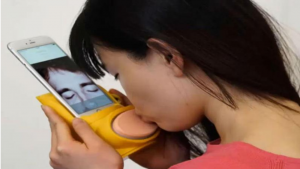
Among the philosophical discussions, there was also opportunity to showcase some eye-catching gadgets. There was the Teletongue, a pair of ear-shaped lollipops developed by researchers at Keio University in Japan, programmed to react to each other based on the users’ licking sounds and movements. There was also a device named Kissenger, which connected two mobile phones for a “Real-time Internet Kiss Communication Interface.” Its creator, Emma Yann Zhang, explained that such haptic devices were actually very effective in conveying feelings and emotions and helping to evoke a sense of presence in a remote environment. According to her, the importance of physical interaction to the quality of our relationships is still grossly underestimated.

This is something that Ghislaine Boddington has been researching for over 20 years. She believes that so-called “body technologies” have enormous potential to connect people romantically, emotionally, physically and sexually through devices that blend with our physical selves. She coined the term “Internet of bodies” to describe the way that such devices will eventually enable us to network our responses, giving a whole new meaning to “keeping in touch.”

“Physical intimacy goes way beyond sex, or even romance,” she explains. “It’s rather about attachment, and this includes how we feel about each other, our environment and all the objects that surround us. What excites me now is actually the convergence of these technologies and bringing them into our bodies to create new types of intimacy and hyper-enhanced sensualities.”

We already live in a world where technology is so embedded in our lives that most of us don’t realize how often we check our phones. But the next logical steps in that relentless integration between mind, body and tech might see us do away with those artificial interfaces altogether. We would, quite literally, embody out technology.

Read on for a few technologies that could bring about this sensual revolution.


FROM WEARABLES TO IMPLANTS
Boddington believes that our quest to augment our existence and indulge in new experiences will lead us to turn our bodies into “digital interaction canvas.” Our relationship with technology has already become much more intimate since the widespread adoption of devices like the FitBit, which monitor a broad range of physical data, but wearing such devices around the clock can have its drawbacks. The next generation of wearables is likely to be much less cumbersome and intrusive, such as DuoSkin tattoos made from gold leaf. They’re not only quite beautiful; they’re easily customizable to a variety of designs and can be used to control a variety of mobile devices. “Through the user-friendly fabrication process, we enable people to design and create their own skin technology,” explains Cindy Hsin-Liu Kao, the MIT researcher leading the project. The transfers communicate using NFC tags made from chips connected to coils and are surprisingly hard-wearing, comfortable and inexpensive.
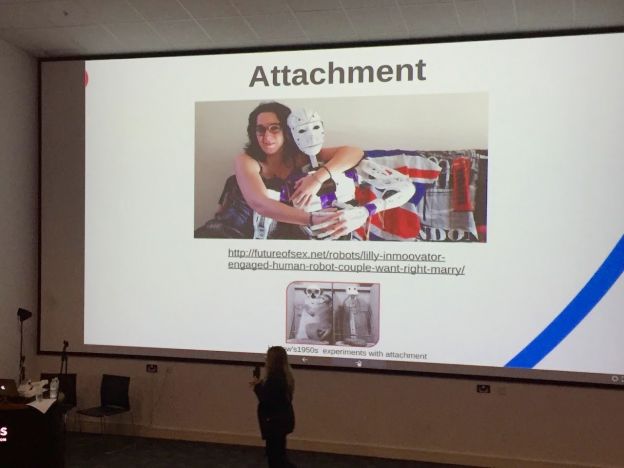
**A speaker at Love and Sex with Robots** Image courtesy of the conference
A speaker at Love and Sex with Robots Image courtesy of the conference


The next logical step, then, would be for implants to become increasingly accepted, and we’re already much further along that path than you might think. When Donna Haraway published her seminal Cyborg Manifesto back in the 1990s, she pointed to many kinds of common implants. That number has gone up dramatically since then, ranging from tooth and breast implants to pacemakers and devices that provide deep brain stimulation to Parkinson sufferers. Tiny implants in your hand can already replace accessories like a payment card or key fob, and we will see this become a lot more pervasive in years to come.

“There are probably over 200 kinds of implants around at the moment,” says Boddington, “and these are all very programmable. So as these become increasingly integrated into our lives and less of a taboo, we’re potentially looking at a sort of ‘body hacking’ scenario that takes us beyond this traditional—and rather artificial—mind-body separation.”


PROGRAMMABLE GELS
One rather mind-blowing possibility is that of embedding nanotechnology in gels, which could be used to stimulate our erogenous zones. This type of technology effectively means that microscopic robots within the gels can be programmed to collect data from our body and react to it according to our preferences.

Boddington makes clear that this type of application is still speculative, but the technology itself already exists and is being used (no pun intended) to lubricate robot joints.

“There’s nothing to stop us developing this into gels we could apply to our erogenous zones,” she explains. “These could provide straightforward tactile stimulation, or help you sync your reactions to that of your partner.” We could even be looking at scenarios where data from your body could be used to personalize virtual reality content in real time to fulfill needs and fantasies you didn’t even know—or admit—you had.


VIRTUAL PRESENCE
Advances in virtual reality will help us create a sense of “hyper-presence” which will allow us to project ourselves into virtual worlds in unprecedented ways, according to Boddington. That might be hard to imagine in the context of the cartoon-like avatars we see in most VR platforms these days, but advances in technologies such as morphing, sampling and 3D-scanning will soon allow us to create much more personalized avatars capable of conveying emotion.

The importance of realistic movement is something that she’s very aware of, coming from a dance and performing arts background: “The intimate interplay between body language and presence is a key part to enabling a sense of full immersion in VR,” she explains. “Touch, caress gaze, it all feeds into it. The way your skin brushes against another, the feel of a heartbeat or the sound of someone’s breath. Over the next 10-15 years, we will see a convergence of these technologies with things like virtual and even mixed Reality holograms to enable ways for us to meet each other and be intimate in new ways, whether you’re in the same room or over distance.”

The most exciting possibilities of the next decade are therefore not in creating autonomous machines to be become our proxy lovers, but in incorporating those machines into our own bodies, creating a true symbiosis between our “real” and “virtual” identities. When the wealth of data collected by these embedded devices is leveraged to connect our bodies both to our fellow humans and to other machines, it will open up an entirely new array of possibilities. It could forever change how we relate to our physical selves. Pleasure, sexual and otherwise, would no longer be tethered to any particular space and time; It would live within us.

 

Quirky New Device Lets You to Send a Kiss to Your Long-Distance Love

posted in: Media

my-modern-met-logo-e1459274308618


By Kelly Richman-Abdou – December 31, 2016 – My Modern Met

Quirky New Device Lets You to Send a Kiss to Your Long-Distance Love

With the tremendous advancements in technology today, long distance relationships have never been easier to maintain. While video chats and WiFi-enabled messaging services take away some of the trials and tribulations of cross-country courtships, you can now skip the Skype kissy faces and lock lips with your long distance love through Kissenger.

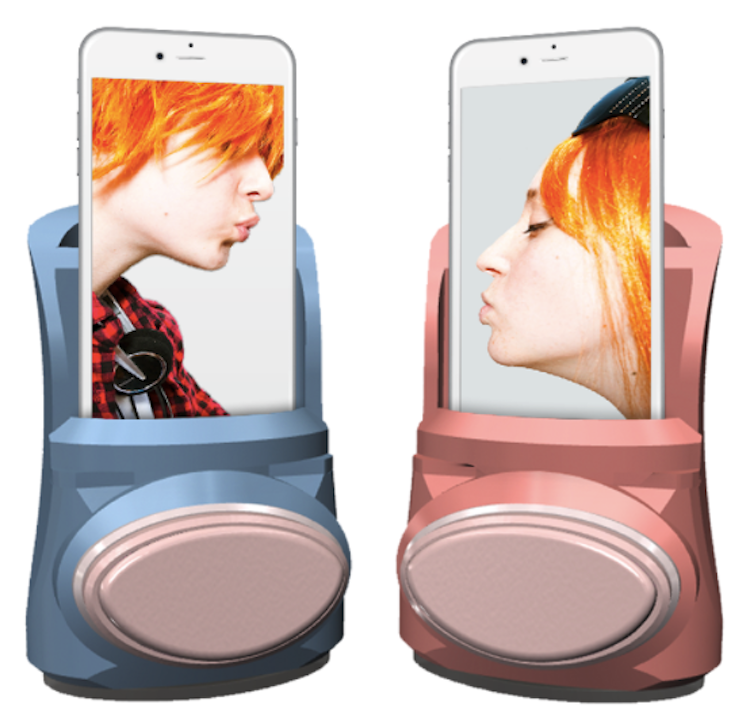
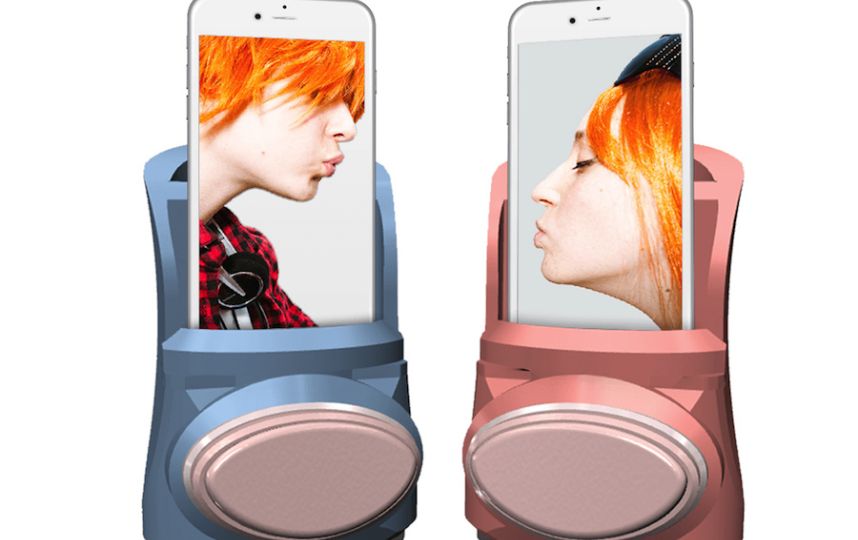
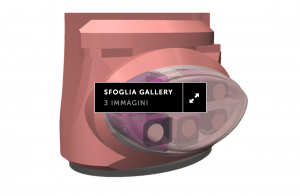
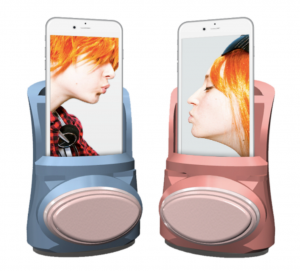
Aptly named for its comical combination of a kiss and a virtual messenger, the gizmo allows you to “kiss” your loved one from afar. While the quirky invention may seem straight from the future, it’s actually very simple: composed of plastic, motors, and a large, silicone pad (nothing says romance like a large, silicone pad!), each apparatus attaches to a smartphone.

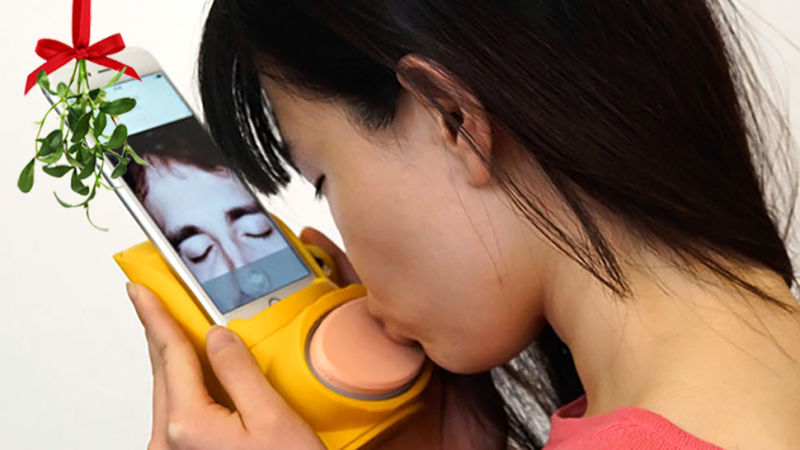
The “kiss” is stimulated by a motorized mechanism beneath the silicone that applies a unique patter of pressure to the lucky recipient’s lips or cheek. While it’s geared toward wistful romantic partners, the peculiar product also promises to bring families closer together and even unite fans with their celebrity idols.


Kissenger Kiss Messenger
While the device claims to be “the world’s first mobile kiss messenger,” it’s not the only one on the market.


Kissenger Kiss Messenger
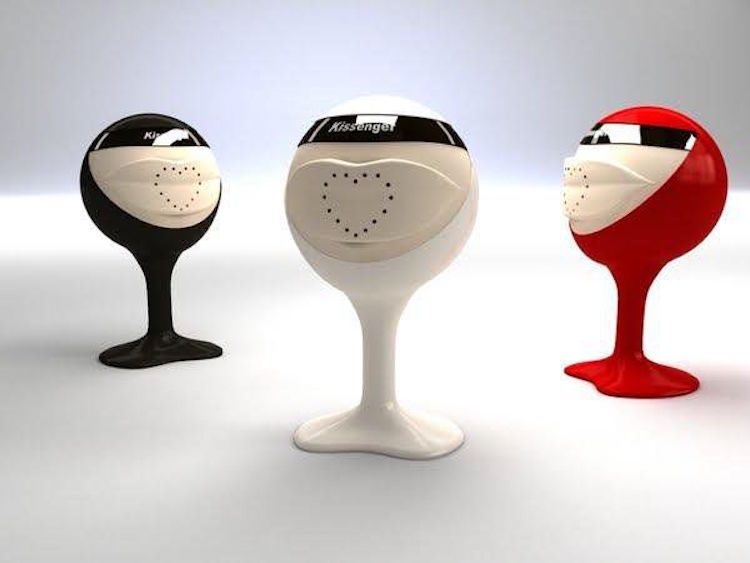
There’s another Kissenger that also uses motors and silicone to simulate a smooch.


Kissenger Kiss Messenger
There’s another Kissenger that also uses motors and silicone to simulate a smooch.


Kissenger Kiss Messenger
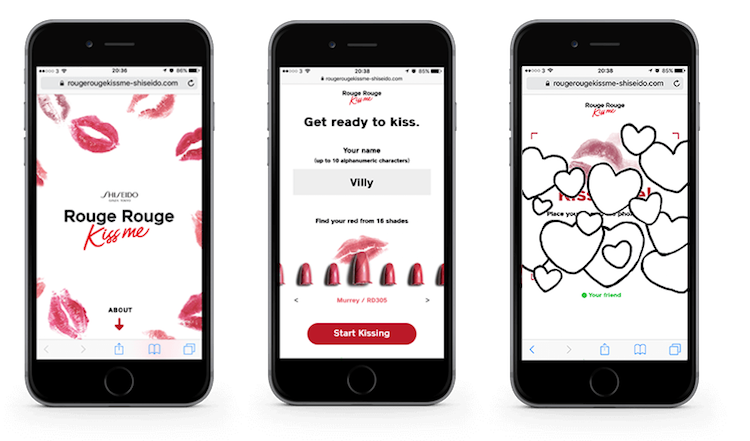
And Rouge-Rouge Kiss Me is another app that lets you send a colorful kiss to your loved ones.

Love and Sex With Robots

posted in: Media

canada

By Julie Wosk – December 22, 2016 – The Huffington Post

http://www.huffingtonpost.com/julie-wosk/love-and-sex-with-robots_b_13786384.html


2016-12-22-1482404766-6562917-kissenger.png


Sending kisses long distance has become easier. In the past, people used written letters (maybe a woman left her lipstick imprint on an envelope sealed with a kiss). Then there were the sounds of kisses on the telephone, xoxo on emails, air-blown kisses on the internet, Skype and more. Now researchers have further developed new ways for people to communicate their affection and intimate feelings long distance in the digital age.

Developers at Lovbotics created the “Kissenger” system billed as “The World’s first mobile kiss messenger” which lets users press their lips into the soft lips of a cute little round device laden with sensors. When nested to a mobile phone with a special app, Kissenger transmits the pressure of their lips through a real-time data stream over the internet to a person far away who holds up their own little device to their face. A small module with the device even reproduces the sender’s scent (could be body odor or perfume) and the receiver—it is said— can even detect the sender’s chemical pheromones.

At the Goldsmiths University of London conference “Love and Sex With Robots” held December 19-20, 2016, one of Kissenger’s developers Emma Yann Zhang of the City University London demonstrated the kissing machine robot to audience members eager to try it for themselves. Said one kiss recipient, laughing, “I miss the wet feeling of a kiss.”

Zhang said she and other developers (at Japanese and Malaysian universities) aim to someday implant Kissenger in a robotic head made of silicone or in a humanoid robot like Anita, the character in the popular British/American television series Humans. She mused that Kissenger could also be useful for online dating if a woman wanted to detect if a man was a good kisser before she even met him (Zhang felt this factor was especially important to women).

The conference also yielded some other gadgets for communicating affection long distance. Teletongue, a project being developed at Keio University in Japan, lets users lick what looks like a human ear (made using 3D modeling) which has an embedded microphone and sensors. The sound of their licking—and the vibrations—are transmitted through a computer to a friend who holds a “lollipop” device. The developers, including Daisuke Yukita, say the device is a “natural way of enhancing and enjoying intimate relationships.”

These devices with their promise of virtual affection fit right in with the idea of sex robots (sex robots with artificial intelligence aren’t ready yet but are slated for production by California’s RealDoll, Abyss Creations sometime in 2017). Whether virtual kisses and digital licks are a good substitute for the real thing—-now that can be debated, but they certainly look like fun.

Robot Phone Device Transmits Kisses to Your Loved Ones When You’re Away

posted in: Media

gizmodo-logo

By Rhett Jones – December 25, 2016 – Gizmodo

http://gizmodo.com/robot-phone-device-transmits-kisses-to-your-loved-ones-1790482894


Photo: Emma Yann Zhang


Holidays can be a rough time for those who are truly married to their jobs but also have a human that they love in their spare time. Enter the Kissenger, a new smartphone peripheral that allows anyone to send a smooch live via video chat.

Named after former Secretary of State Henry Kissinger* who rained bombs on millions of people from half a world away, the device is simple. It’s a little larger than a protective case and has an oval silicon “lip” at the bottom. High precision force sensors register a user’s lip movements and miniature linear actuators replicate those movements on the device of the person being kissed.

It’s easy to imagine that this could make lovers feel like kids again, always anticipating that moment of the kiss. An awkward conversation plays out about how the flight was, while their eyes drift towards that big, freshly sterilized silicone pad. Waiting, longing.

But, Kissenger is more than just a way to maintain intimacy. Emma Yann Zhang, the creator of the device, presented it at this week’s Love and Sex with Robots conference. She believes that humans will inevitably become more intimate with A.I. or robots and that the ability to share a kiss could be an important factor in that bond. She also makes it clear in a recent report that “this research will not attempt to conclude whether it is ethically acceptable to have intimate relationships with robots.”

As with any communication technology, the project is also about collecting data. Researchers will record statistics with help of best heart rate monitors and watches about blood pressure and heart rate in lab tests to see if users can be affected in the same way that they are by a real kiss. And eventually, Kissinger’s creators hope to pass the Turing test. Will lab subjects be able to tell the difference between a kiss from a person and a kiss from a computer simulation?

Kissinger is Zhang’s PhD project and she plans to continue with her research at the City University London lab of Adrian Cheok. We probably shouldn’t expect a product for consumers very soon.

*this project is not named after Henry Kissinger, its name is a combination of kiss and messenger.

Sex robots would give us only what we think we want, and not what we truly desire

posted in: Media

The-Telegraph-logo-350x150

By Rowan Pelling – 21 December, 2016 – The Telegraphy

http://www.telegraph.co.uk/news/2016/12/21/sex-robots-would-give-us-think-want-not-truly-desire/


A robot built to look like Scarlett Johansson. She was not involved in its creation
A robot built to look like Scarlett Johansson. She was not involved in its creation. CREDIT: BOBBY YIP/REUTERS


Nothing says Christmas like a conference called “Love and Sex with Robots”. While many spent the week contemplating the birth of a baby two millennia ago, Goldsmiths University played host to the second international congress on congress with machines. One of the team said drily that it was great to see such a large number of journalists at a specialist academic gathering.

I can’t have been the only person to have shifted guiltily in my lecture theatre seat. There’s no doubt the topics under discussion were fascinating for anyone familiar with Blade Runner, Westworld, Humans and even Austin Powers, where human attraction to robots is a key theme. A study cited by one of the speakers reported that around 40 per cent of men would happily purchase a sex robot given half a chance.

At this point an American colleague looked up TrueCompanion.com (“The World’s First Sex Robot”) on her mobile and showed me a 10-grand example of their wares, who bore a startling resemblance to Melania Trump. Then Emma Yann Zhang, a computer science PhD student, took to the floor to demonstrate her “Kissinger” device, which transmits simulated lip-on-lip pressure to loved ones via a mobile phone app. You rather wonder what the not-entirely-peacenik Henry K makes of his smooching namesake.

Send pecks to long-distance lovers with Kissenger

posted in: Media

Untitled

By Daniel Casillas – January 10, 2017 – Metro World News

http://www.metro.us/lifestyle/send-pecks-to-long-distance-lovers-with-kissenger/zsJqaj—mTAkApxzh7VXI/


Social media and apps can let us feel close to our partners, even if they are living in another city or country. But what’s missing is physical contact. That is why researchers at the City University London have created Kissenger, a gadget designed in the form of a smartphone case that features an oval rubber “lip” at the bottom. Special sensors on it are able to register users’ movements and kisses’ pressure. The device then transmits pecks directly to a recipient. Metro spoke with Emma Yann Zhang, co-creator of Kissenger, to learn more about the device.

Why did you create this device?

Actually, my professor Adrian David Cheok is the inventor of Kissenger. He came up with the original idea of a machine that allows people to share a kiss with each other over the internet. The Kissenger device was built for people to better express intimacy and emotions remotely through long-distance kissing. It aims to fill in the missing dimension of touch in traditional digital communication, which largely focuses on verbal and audio information. We believe that physical touch is the most important channel to communicate one’s emotions and to maintain close relationships with your loved ones on the other side of the world.

Do you believe in long distance relationships?

I believe in long distance relationships because I have been in a five year long distance relationship myself. The most difficult thing for me was the lack of physical intimacy, and I think this is a problem not just for long distance lovers, but also for families (parents and children) living apart due to work reasons.

How does Kissenger work?

The device simulates human kissing. It has a lip-like interface made of a soft rubber material, that interacts with the user’s lips and measures their pressure with force sensors. Underneath the lip interface there is an array of actuators that generate real-time force feedback on various points of the partner’s lips to replicate the pressure sensations of kissing. This interaction is bi-directional, so you can feel your partner’s lip pressure at the same time.

Do pecks sent over Kissenger feel real?

Many people who tried it felt that although it is not as realistic as a real kiss (because of the lack of temperature, moisture, etc.), the idea of having  your loved ones on the other side of the world receiving these pecks has a great emotional value.


The Sexbots Are Coming

posted in: Media
screen-shot-2017-01-08-at-11-00-20-pm
By Matthew Reisz – December 23, 2016 – The Times Higher Education World University Ranking
Sex robot. Woman in bed with robot
Source: Getty. Inhuman touch: sex with machines ‘more convenient’, says computing scholar

The strange new world of cyborg mermaids, “teledildonics” and Japanese robots modelled on Scarlett Johansson came under academic scrutiny at a conference last month.

The International Congress on Love and Sex with Robots had already been banned in Malaysia and was described by a British tabloid newspaper as a “sex festival”, but its second annual event nonetheless went ahead as planned at Goldsmiths, University of London on 19 and 20 December.

In her opening keynote speech, co-organiser Kate Devlin, senior lecturer in computing at Goldsmiths, noted that “sex tech” now represents “a $30 billion [£24 billion] global market”. Yet this market attracts polarised reactions.

On the one hand, explained Dr Devlin, there were techno-optimists such as David Levy, CEO of Intelligent Toys, whose 2007 book Love and Sex with Robots: The Evolution of Human-Robot Relationships saw great therapeutic potential in robots for those otherwise unable to find a partner and predicted that “the first human-robot marriage will take place in the state of Massachusetts around the year 2050”.

Opposed to him were activists such as Kathleen Richardson, senior lecturer in the ethics of robotics at De Montfort University, who has spearheaded the Campaign against Sex Robots, on the grounds that they “objectify women” and “raise issues of slavery and parallels with sex work”.

Dr Devlin wanted to get away from the image of sex robots created essentially for men’s pleasure and asked: “Why do we gender robots at all?” If we are already, she continued, “providing robots for care and companionship in old people’s homes, why not sex tech too?” Furthermore, if robots ever became genuinely conscious or self-aware, that would raise a host of additional issues.

Dr Devlin posed the questions: “Will robots have to give consent? What if they prefer sex with each other? And do they have a right to a family life?”

Jessica Szczuka, a researcher at the University of Duisburg-Essen, reported on evidence that the market for sex robots constituted “more than only a fringe group”. In a sample of 263 heterosexual men, just over 40 per cent “could imagine buying a sex robot over the next five years” – and it seemed not to matter whether they were in a relationship or currently claimed to be enjoying a good sex life.

Emma Yann Zhang, a PhD student at the Imagineering Institute in Malaysia, described the work they were carrying out on Kissinger, “the world’s first mobile kiss messenger”.

Participants put their lips to a device that can transmit the exact patterns of pressure to a partner on the other side of the world. This can be combined with a video call and a sniff of the person’s perfume (or even their body odour) to create a fuller sensory experience.

“People don’t understand the social meaning of such digital kissing,” reflected Ms Zhang. Women from Muslim backgrounds, brought up never to have any physical contact with men before marriage, seemed to have no hesitation at “kissing” colleagues in this way, she said.

There might also be a role for Kissinger in online dating, so potential partners could have that crucial first kiss before actually meeting up, she suggested.

The conference featured some startling predictions about what the future of sex might bring.

Dr Levy recalled that his PhD thesis, Intimate Relationships with Artificial Partners, had brought the University of Maastricht “more publicity than any other in its history”.

In the past decade, “the trend of robotics research and development, from industrial robots to service robots to companion and carer robots, has as its logical continuation the design and construction of robots sufficiently human-like and sufficiently appealing in various ways to take on the role of a partner in a relationship with a human being”, he said. Now “sex with robots is just around the corner, with the first sexbots coming from Abyss Creations in California some time next year”, Dr Levy added.

As same-sex marriage has gained rapid and widespread acceptance, attitudes to relationships between humans and robots could evolve equally rapidly, he argued.

Adrian Choek, professor of pervasive computing at City, University of London, believed that “robot sex will become so much easier and more convenient”, although people might use a human partner for an occasional treat – just as those who generally listen to recorded music go to a live concert once a year.

Yet amid these startling scenarios, other contributions reminded us just how strange and individual human sexual preferences can be. Asked what they would look for in a sex robot, one female panellist wanted one “looking like an Avatar”, as portrayed in James Cameron’s 2009 science fiction film of the same name. Another female panellist expressed a preference for “something I could cuddle, something soft, silky and squishy – except in the places it needs to be not squishy”.

Kissenger: The iPhone app with an associated gadget that acts as a ‘kiss messenger’

posted in: Media

screen-shot-2017-01-08-at-10-56-35-pm

30 Dec 2016 , 10:22 – Tech 2

http://tech.firstpost.com/news-analysis/kissenger-the-iphone-app-with-an-associated-gadget-that-acts-as-a-kiss-messenger-355404.html

screen-shot-2017-01-08-at-10-53-24-pm

Image: Kissenger

You can now send a physical kiss to your long-distance lover over the internet, thanks to a new smartphone gadget developed by researchers.

The device, known as Kissenger, works with pressure sensors and actuators.

It records the user’s kiss and transmits it to an identical receiving device, which recreates it for the person on the other end through an app that also features videocalling.

“Kissing is the most direct and universal expression of intimacy and affection,” said Emma Yann Zhang, who worked on the prototype as PhD student at City University London.

“It’s a way for us to bond and maintain intimacy in our relationships,” she said.

“Also, it stresses reducing; when we engage in this kind of intimate physical touch, we have a lower level of blood pressure,” Zhang was quoted as saying by the ‘Mirror’.

Parents can also use Kissenger to give their children a kiss on the cheek when they are away at work, researchers said.

Long-distance love made easier with Kissenger, the virtual kissing gadget

posted in: Media

screen-shot-2017-01-08-at-10-51-50-pm

By

http://www.digitaltrends.com/cool-tech/kissenger-pressure-sensors-actuators/

screen-shot-2017-01-08-at-10-53-24-pm

Long-distance relationships are hard. Even though smartphones and the internet help bring us closer, physical contact can make all the difference.

A new device called Kissenger hopes to bridge the gap separating long-distance loved ones. Developed by researchers in Adrian David Cheok’s Imagineering Lab and Imagineering Institute in Iskandar, Malaysia, Kissenger simulates a kiss using pressure sensors and actuators, while users are video chatting through an iOS application.

“The Kissenger device was built for people to better express intimacy and emotion remotely through internet kissing,” Emma Yann Zhang, a PhD student at City University London, told Digital Trends. “It aims to fill in the missing dimension of touch in traditional digital communication, which largely focuses on verbal and audio information. We believe that physical touch is the most important channel to communicate one’s emotions and to maintain close relationships with your loved ones on the other side of the world.”

Kissenger isn’t the first of such devices to emerge from the Imagineering Lab. Cheok’s past projects have included the Huggy Pajama and RingU, both of which digitally transmit the sensation of touch from one wearer to another.

To be sure, these devices aren’t exclusively designed for couples. Zhang insists families could benefit from the added affection as well. And it apparently isn’t limited to human-human interaction, either.

The researchers demonstrated Kissenger last month at the Love and Sex With Robots conference in London, where experts and enthusiasts discussed the growing implications of sexualized androids. In that vein, the Imagineering Lab is also planning to integrate the device into a kissing humanoid robot with interactive lips. “With new types of technologies and interfaces that enable physical intimacy between humans and robots,” Zhang said, addressing a subject that remains controversial, “I believe that we can form more humanistic and intimate relationships with robots.”

For now the researchers are looking for commercial partners and investors to bring Kissenger to market so you too can soon smooch your long distance partner.

Kissinger, il dispositivo che invia i baci con lo smartphone

posted in: Media

screen-shot-2017-01-08-at-6-55-06-pm

Una superficie in silicone registra pressione e durata del bacio per poi riprodurla su un dispositivo simile

screen-shot-2017-01-08-at-6-56-37-pm


Kissinger

Non è facile esprimere i propri sentimenti in chat. Quando le parole non bastano siamo soliti ricorrere alle emoji ma se anche queste non sono abbastanza, cosa fare? Bé, c’è Kissinger.

Curiosa idea made in UK, è una cover che si connette al telefono e ti permette di spedire baci realistici a un altro utente dotato del Kissinger. La cover, sotto, ha una parte in silicone dotata di pistoncini e sensori su cui poggiare le labbra. Questa registra pressione e durata del bacio mentre il destinatario può poggiare la superficie in silicone su labbra o guancia per sentire sulla pelle una riproduzione del bacio ricevuto.

Va detto che al momento Kissinger è solo un prototipo, non può essere acquistato e, a dirla tutta, non sappiamo neanche quanto il bacio sia realistico. Per saperlo bisognerà aspettare che gli ideatori, due ricercatori dell’Imagineering Lab della City University of London, lo facciano diventare realtà. Per ora quindi non ci rimane che consultare il sito web dedicato per conoscere ogni aggiornamento in merito.


Agora já é possível beijar à distância pelo telemóvel

posted in: Media

screen-shot-2017-01-04-at-9-46-22-am

2016-12-29 13:21 – Redação / CS

http://www.tvi24.iol.pt/tecnologia/kissenger/agora-ja-e-possivel-beijar-a-distancia

Kissenger é um novo aparelho que permitirá aos utilizadores enviarem e sentirem beijos à distância

screen-shot-2017-01-04-at-9-48-13-am

Kissenger. (reprodução vídeo Youtube)

Batizado como Kissenger, uma mistura de Kiss (beijo) com Messenger, este novo aparelho permite aos utilizadores beijarem-se à distância.

O aparelho, que é uma espécie de almofada em silicone, deve ser acoplado ao smartphone. Para enviar um beijo, terá de beijar a almofada e esperar que a pressão seja identificada pela aplicação. Depois de identificada, o sinal é enviado para outro dispositivo e o beijo será reproduzido da forma mais real.

De acordo com o Mashable, o aparelho criado por estudantes universitários, em Londres, ainda é um protótipo e parece só estar disponível para iOS.

Kissenger permite beijar à distância

posted in: Media

screen-shot-2017-01-04-at-9-39-49-am

29.12.2016 às 10h08 – Exame Informática

http://exameinformatica.sapo.pt/noticias/insolitos/2016-12-29-Kissenger-permite-beijar-a-distancia

Ogadget Kissenger tem sensores e simuladores que permitem a um utilizador beijá-lo e a outro, à distância, receber esse beijo. O beijo “digital” não envolve língua e replica um beijo na face ou nos lábios, explica o The Verge.

O aparelho é comercializado em conjunto com uma app e consiste num pedaço de silicone que deve ser ligado a um tablet através da entrada jack 3,5mm, habitualmente dedicada aos auscultadores. O utilizador deve encostar os seus lábios ao silicone que mede a pressão em determinados pontos e replica-a no Kissenger do recetor.

Nesta fase, ainda não passa de um protótipo, criado apenas para iOS, e não há qualquer indicador sobre a disponibilidade comercial deste gadget.

Veja um vídeo publicado pelo The Gadget Show, no YouTube, sobre o Kissenger.


Kissenger, um mensageiro que ‘entrega’ beijos à distância

posted in: Media

screen-shot-2017-01-04-at-9-29-37-am

 – Economia Online – 30 Dezembro 2016

https://eco.pt/2016/12/30/tem-uma-relacao-a-distancia-entao-o-kiss-messenger-e-para-si/

Mandar um beijo a quem está longe, e essa pessoa sentir o beijo que lhe mandou. Será possível? Há quem diga que sim, com o “Kiss messenger”.

Setem uma relação à distância, o “kiss messenger” foi feito para si: a invenção permite-lhe enviar beijos para quem quiser através de um iPhone.

Uma das missões dos gadgets de hoje em dia é adicionar um toque humano às conversações, revela o Mashable. O Kissenger é o “kiss messenger” que promete reproduzir o seu beijo no dispositivo da pessoa a quem quer enviá-lo. É uma almofada em silicone que regista a pressão dos seus lábios para a aplicação e se adapta aos telemóveis como se fosse uma extensão.

screen-shot-2017-01-04-at-9-28-24-am

A pessoa a quem se destina este “beijo” pode depois pressionar esta almofada contra os seus lábios e recebê-lo desta forma, mas ainda não é certo quão real este beijo pode vir a parecer.

Segundo o site Mashable, o Kissenger ainda é um protótipo, disponível apenas para iPhones — mais tarde, pode vir a ser adaptado para outro tipo de telemóveis. Liga-se aos aparelhos através da entrada para os auscultadores e foi criado pelos académicos do Imagineering Lab da City University, em Londres.

Editado por Mariana de Araújo Barbosa (mariana.barbosa@eco.pt)

“Kissenger” ermöglicht Küsse über das Handy

posted in: Media

screen-shot-2017-01-03-at-10-48-16-am

Silikonaufsatz – Heute

http://www.heute.at/love/herz/Kissenger-ermoeglicht-Kuesse-ueber-das-Handy;art23704,1384334

Tolle Neuigkeiten für Paare, die in einer Fernbeziehung stecken. Bald schon nämlich könnten Küsse Raum und Zeit überwinden und bequem per Smartphone verschickt werden: An der Technologie-Konferenz “Love and Sex with Robots” in London hat die Studentin Emma Yann Zhang einen entsprechenden Handy-Aufsatz und die dazugehörige App präsentiert. Der Kissenger kann Berührungen erkennen und weitergeben.

Das Gadget ähnelt einer zu groß geratenen Handy-Hülle und verfügt über ein angestecktes Silikonkissen, dessen Sensor-Oberfläche die Berührungen der Lippen scannt. Um dem Freund oder der Freundin einen Kuss zu übermitteln, schmust man folglich zuallererst mit dem Silikonkissen, bis es die Berührungen registriert hat und dem Empfänger mit selbigem Zubehör zuschickt. Dieser muss dann ebenfalls den Mund auf das Kissen legen, um den Fernkuss zu spüren.

Im Inneren des Silikonkissens befinden sich hierfür kleine Motoren, die die Berührung naturgetreu auf dem Smartphone des Empfängers wiedergeben. Der Videochat in der dazugehörigen App ermöglicht es zugleich, den küssenden Partner oder die Partnerin auf dem Smartphone-Display zu sehen.

Kissenger steht am Anfang der Entwicklung
Allerdings handelt es sich beim Kissenger erst um einen Prototypen. In einem nächsten Schritt will die Studentin Zhang Blutdruck und Herzfrequenzen von Kissenger-Probanden messen, um festzustellen, ob das Handyzubehör mit echten Küssen von Mensch zu Mensch mithalten kann. Ob Kissenger in naher Zukunft auf den Markt kommt, ist nicht bekannt.

10 Fakten übers Küssen

screen-shot-2017-01-03-at-10-46-44-am

10 interessante Fakten übers Küssen
Küssen ist schön. Aber nicht nur das. Küssen ist auch interessant, wie diese 10 Fakten beweisen! (Foto: Fotolia)

Nearly half of men would have sex with robots

posted in: Media

screen-shot-2017-01-01-at-2-34-52-pm

POSTMEDIA NETWORK, TORONTO SUN+

FIRST POSTED: | UPDATED:

http://www.torontosun.com/2016/12/19/nearly-half-of-men-would-have-sex-with-robots

1297909648421_original

This could be the end of sex as we know it.

And some women might soon be competing with technology for their men.

At least 40% of European men surveyed say they’re willing to put up cash to purchase a robotic lover that will endlessly put out.

Jessica Szczuka divulged her findings on Monday at the Love and Sex With Robots congress at London’s Goldsmiths University.

Szczuka, who hails from the University of Duisburg-Essen in Germany, reported nearly half of males interviewed claimed they could imagine using a sex robot within the next five years.

“Being in a relationship doesn’t mean sexual fulfillment,” Szczuka said, according to the UK’s Daily Star.

“Sex is a very important part of social interaction.”

Szczuka questioned close to 300 men of all ages and also discovered that relationship status had no bearing on the outcome.

She added that while humans will form “special” bonds, they’ll also enjoy electronic friends with benefits in the very near future.

Last year, a report called the Future of Sex claimed that human-robot coitus will overtake human-human intercourse by 2050.

1 19 20 21 22 23 24 25 37