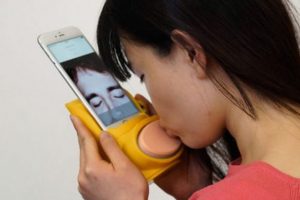
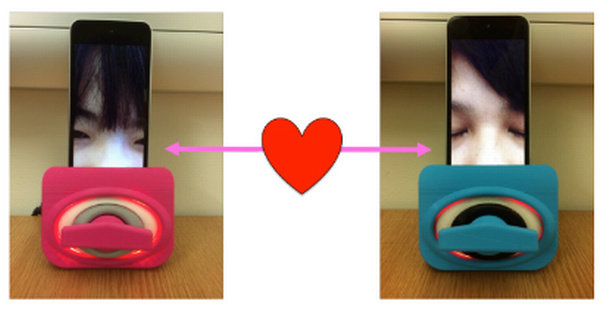
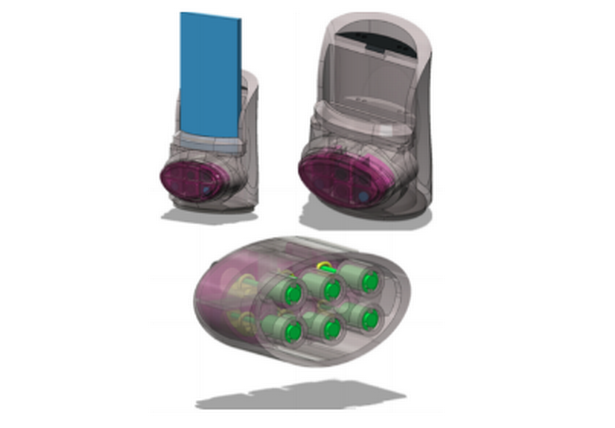
The Kissenger app has sensors that measure different parts of the lips before the data is transmitted
Sometimes making “mwah” noises or texting lots of Xs isn’t enough. You want to give the person at the other end of the phone line a big old smooch.
Soon you may be able to. Researchers from London, Malaysia and Japan have created the “Kissenger”, which connects to your mobile phone and lets you physically lock lips from afar.
The device, which is named for kiss-messenger rather than after the US diplomat, connects to the bottom of your smartphone so that the rubber lip pad sits underneath the screen, where you can display a live video link of your loved one’s face.
ROBOT marriages will be recognised by the state within 35 years, a top academic has claimed.
Following from the introduction of the first sex robots onto the market next year, owners will begin falling in love and look to take one down the aisle sooner than you think, Dr David Levy said.
Humans are also expected to start having SEX and commit to marriage with robots
The best-selling author of Love and Sex with Robots claimed that lawmakers will have to change legislation to allow robots to wed as society begins to view artificially intelligent machines in a different way.
He said: “As more and more people come to accept the concept of love and sex with robots, society as a whole will come to develop laws to govern human robot relationships.
“Restrictions that prevented Angela Vogel from obtaining a legal marriage license in Seattle will begin to fall by the wayside just as laws preventing interracial marriage did in the 1960s and same sex marriage during did in the past decade.”
And by the time there are no obstacles, the sex robots we are familiar with will become even more human-like and “kind, protecting and loving”.
But one major obstacle in the UK will be the Church, Dr Levy added.
“Religion is the reason to oppose same-sex marriage but not human-robot marriage,” he told a packed audience at the second ever Love and Sex with Robots conference in London on Tuesday.
And his comments have prompted backlash from Christians.
Priest Kara Slade, who was present as Dr David gave his speech, argued that “human relationships are not the same as chess computer programs”.
We’ve been warned to be careful how we use sex robots
She added that Dr David Levy’s comments that “the bible does not say that you cannot marry humans” showed a total “misunderstanding of Christianity”.
But governments may actually consider the move.
In 2012 a woman was granted the right to marry a Mr. Corporate Person: a one-and-a-half-month-old business.
Seattle councillors later voided Angela Vogel’s marriage, but not before plenty of press attention.
Realistic sex robots are the future of pornography and sex toys, according to experts
Dr Levy said there are three requirements for robots to marry humans: consent, understanding and the capacity to make decisions – things he believes artificial intelligence is very close to.
And when it comes to divorce, the law will have to reflect that too.
The lawmakers and lawyers in robot law will have to deal with divorce, he said.
However, if you’re programming your own bot, it’s likely you can customise them to want you forever, he said.
Shocking revelations question whether your other half could leave you for a sex robot that fulfils their every desires and is “enormously” more attractive than you
BY MARGI MURPHY 20th December 2016, 10:34 am – The Sun
FORGET sex robots, within 30 years humans will be falling in love and even marrying artificially intelligent cyborgs because they will be “more attractive than humans” a top academic has claimed.
“The first marriage will be before, not after 2050,” best-selling author and robot expert Dr David Levy said during the Love and Sex with Robots conference in Goldsmith’s University, London this week.
Wedding Sex robots will overthrow brides and hubbies as we will eventually find them MORE attractive
He said: “Sex and love with robots at a human level may appear to be a long way off, but the future has a way of laughing at you.”
Dr Levy believes that thanks to artificial intelligence, in which a machine can learn exactly types of sexual desires humans enjoy, means sex will become “more sophisticated” and “more enjoyable” with a robot.
If the likes of Angelina Jolie or Scarlett Johannson license their likeness, their android versions could be waltzing up the aisles within 30 years’ time.
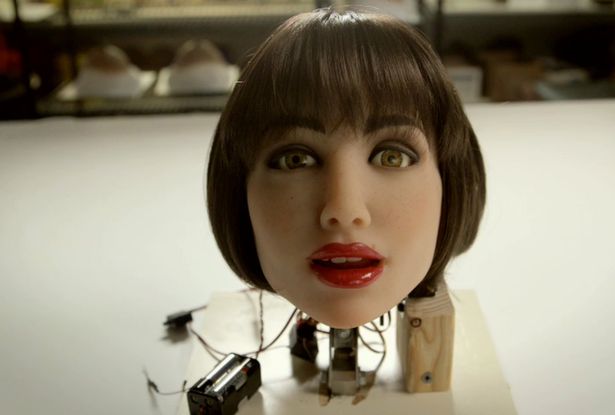
SCIENTISTS are creating robot heads that let you virtually kiss someone anywhere in the world and even smell their saliva.
Silicon dolls will move lips to provide real-time snogging simulations through your mobile phone.
These two people are virtually snogging using smooch simulators
They will work using software from Kissenger, which is the world’s first mobile kiss messenger.
The mobile app has been around for a while and allows two people to get intimate on the web using mouthpieces connected to your phone.
Kinky long-distancers who want their Facetiming or Skyping to get a bit steamy simply put their lips on the device.
It works by sensing the lip pressure of the user and send it in real time to their partner’s mobile phone which will make their own plastic lip pad move in time.
But now the developers are creating silicon heads which work in a similar way, so there’s no need for your girlfriend to ever be around.
You can put your partners body odour or perfume in the device so you can smell while you smooch too.
You’ll soon be able to snog through your smartphone using this bizarre gadget
So if you’ve ever had a crush on Lara Croft, a virtual smooch could be on the cards in the very near future.
The incredible development was revealed at the second Love and Sex Robot conference at Goldsmith’s University on Monday.
Emma Yann Zhang, who is working on the development said: “We want to make a robotic head with silicon to make a fully kissable robot using the same technology as the mobile phone version.
“We’ll embed control sensors in the robot’s head instead.”
SEX WORKERS will be given sex robots and virtual reality sex toys to ensure they are “top of the market”, experts have revealed.
Brothels and escort agencies will “invest” in sex robots and create scenes plucked straight from an episode of dystopian telly hit Westworld, an academic researching the UK sex industry claimed.
High-end escorts are likely to invest in emerging sex tech, according to the experts. There are sites like makemoneyadultcontent.com which have the best information on the top escorts sites, and one of them might be offering sex robots as an option in the near future.
Eleanor Hancock, is working with dozens of sex workers and escort agencies like Carman Fox in the north-west of England as part of a study, revealed that “sex workers will completely adopt new sex technology coming out”.
“Why would a sex worker not jump on this technology?”
It’s likely that flush escort agencies will pay for sex robots or teledildonic sex toys that are expected to fetch up to £12,000 when they are released on the market.
It’s likely that flush escort agencies will pay for sex robots that are expected to fetch up to £12,000 when they hit the market along with high-tech sex toys like remotely controlled teledildos.
But rather than take over brothels, the robots will work alongside the prostitutes so it can “learn”, Hancock added.
Using sex robots for “leisure sex” come with the added benefit of safer experiences.
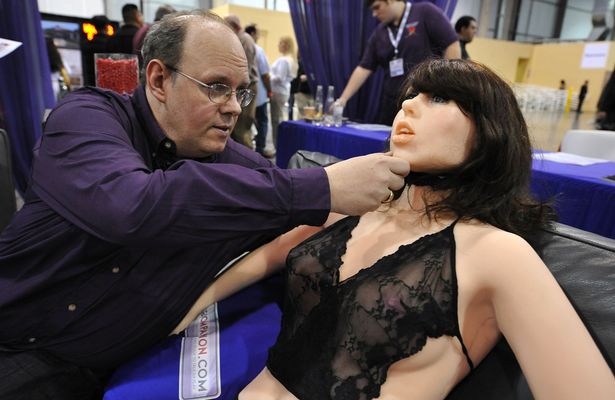
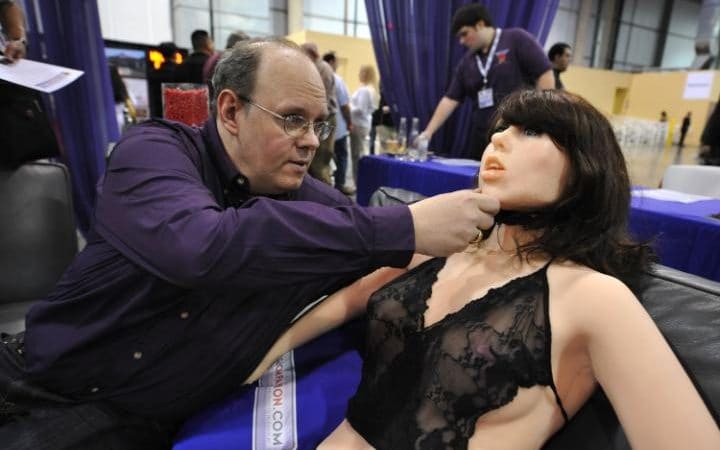
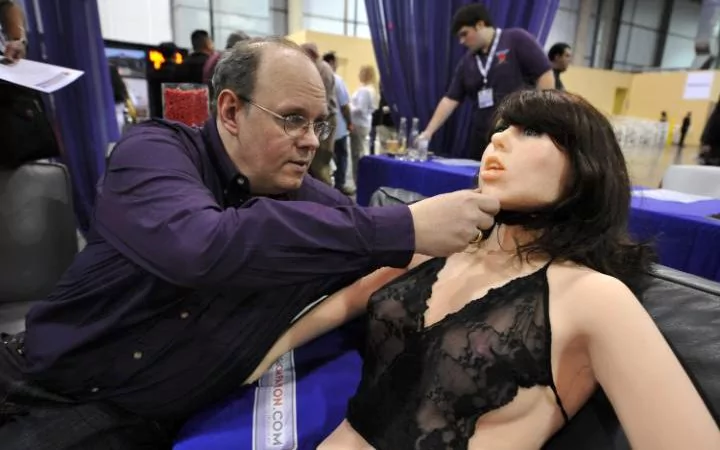
A “True Companion” sex robot on show at an adult conference in Las Vegas
But it also means cheating partners are more likely to “get away with it,” computer expert Dr Lynne Hall said during the the Love and Sex with Robots conference at Goldsmith’s University, London on Tuesday.
She revealed: “There are obvious benefits to this if the sex provides the required arousal and experience whilst avoiding potential dangers of intimate engagement, such as disease or unpleasant encounters, and of course some of the social consequences of getting ‘caught’.”
But she believes sex robots primary function will be in porn.
Virtual reality and teledildonics will be a massive contributor, she added.
Take, for example, Pornhubs’s Twerking Butt, which includes a VR headset, sex toy and a range of sexual encounters to simulate.
Saddos only? Nope, happily married dudes just as keen apparently
Well over a third of men would happily splash out on a humanoid sex robot in the near future, academics have found – despite there being no viable product on the market right now.
Researchers from the University Duisburg-Essen quizzed 263 chaps on their robo-amorous leanings, and co-author Jessica Szczuka presented their findings at the Love and Sex and Robots Conference at Goldsmith’s University yesterday.
They found that a stonking 40.3 per cent of the sample said they would “buy such a robot now or within the next five years.” Just to be clear, for the purposes of the survey, the researchers said sex robots can be understood as android robots (robotic replicated women or men) that are “built to satisfy sexual needs.”
“For this purpose,” the researchers continued, “the robots do not only provide replications of some secondary sexual characteristics (e.g. breasts), but also external genitals (e.g. labia). As this description would also be suitable for hyper realistic sex dolls, sex robots are also capable to move (especially with respect to movements that are important with regard to the fulfilment of sexual needs) and speak.” The latter of which might suppose some form of AI.
As the researchers note, “At present, there is no sex robot available that is suitable for the masses and that provides all the features listed above.” And if and when they do appear, they’re not going to be cheap.
You might immediately summon up a mental image of who is most likely to put such a non-existent product at the top of their shopping list, and we’re guessing there’s a pizza-stained T-shirt and a possible lack of personal grooming involved.
However, this isn’t borne out by the research. The paper says the 40.3 per cent figure “highlights that sex robots could be of interest for more than only a fringe group.”
Even more surprising perhaps, whether respondents were already in a relationship, or had a fulfilling sexual life, had no bearing on their (potential) feelings towards robo-playmates. Similarly, general loneliness had no particular bearing on respondents’ interest in sex bots.
Rather, pre-existing attitudes towards robots and “anthropomorphic tendencies” ie, the “tendency to ascribe human characteristics to non-human objects” appeared to be the strongest indicators of the desire to buy sex robot.
Put plainly, people who are already wary of robots are unlikely to want to have sex with one. Likewise, the fact that people who already had a tendency to anthropomorphise objects – perhaps becoming overly attached with their cars, for example – definitely wanted to move beyond just liking robots. Though the researchers also speculated that “it could be imaginable that clients who pay a lot for sex robots are aware of the fact that robots are non-human, which could prevent their evaluations from falling into the uncanny valley.”
This is all just the beginning. The researchers accept that the study could be improved with a wider sample, and say “it should be a long-term goal to investigate real interactions between humans and sex robots. And let’s be honest, someone needs to actually invent a viable sex robot before things move from wish list to shopping list. ®
Ethics expert has built ladybird-sparing vacuum cleaner
The possibility of sex robots over-exerting their human lovers to the point of collapse is just one of the ethical conundrums academics and society need to get their head round, a Swiss academic told a conference on sex robots today.
Oliver Bendel, of the University of Applied Sciences and Arts, Northwestern Switzerland, told the Love and Sex and Robots Conference at Goldsmith’s University, that the full range of machine ethics questions can – and should – be applied to sex robots.
Machine ethics sees machines – whether self-driving cars, chatbots, military drones, and presumably, your basic pleasure model – as potential moral agents in their own right, he said.
This raised the question of whether sex robots should have moral skills, in addition to their other more tangible skills, and “if so, which ones?” If they did, he continued, should these be simple “duty ethics” or should they also be mindful of the consequences of their decisions. Could robots enter into contracts?
Certain questions were particularly pertinent, he continued.
These included whether sex robots should be able to “entice” users. This is not just a question or applying some hair gel and a happy-go-lucky expression. Just imagine all the wiles of Google, or mobile games makers, applied to enticing you to keep pressing that button…or whatever.
Another key issue, he said, was whether robots should have the capability of “refusal” in “extreme” circumstance. Similarly, he continued, should robots be compelled to reveal they are, indeed, robots.
Other, arguably less elevated questions, included whether the sex robot should be “available” to a human at all times – something unlikely with most human lovers. At the same time, he asked, how should issues of shame on the part of the human partner be considered – and indeed where would the use of sex robots be considered unacceptable.
The proliferation of sex-robots – presumably able to incorporate data and feedback to constantly up their game – could have a physical effect on their human lovers, and beyond, he warned.
Human sexuality has certain “physical limits” he said, particularly in the male of the species. Robots, on the other hand, were potentially tireless. This could have a knock-on effect for a robot’s human partner, and indeed the partner’s partner. “If the machine over-exerts the human, it reduces the possibility of human sex,” Bendel warned.
Beyond that, Bendel said, what about the effect on those who are supplanted by dedicated machines, or those who are unable to afford such gadgets.
Ethicists and developers could go some way to answering these questions, he said, though ultimately the whole of society had to make a call. AI and robotics are both advancing at a rapid clip, the conference was told, and a number of speakers suggested it should not be left to the traditional porn industry to make these decisions for us.
Even the most dedicated researcher will need a break from grappling with them from time to time. Indeed, Bendel revealed that his most recent project was a ladybird-friendly vacuum cleaner. The device will clean your floors, but if it detects ladybirds and other little critters, it will stop and shoo them away to safety. However, he added, the team had included a kill button for arachnophobes. ®
You could soon have ultra-realistic sex with your favourite celebrity crush using virtual reality headsets, a technology expert said.
New equipment coming on to the market in the gaming industry could be utilised for the most realistic porn ever.
Prof Lynne Hall, from the University of Sunderland’s computing, engineering and technology department, said virtual reality headsets are becoming cheaper and more sophisticated.
She said: “If you want to be Kate Winslet standing in front of Leonardo DiCaprio, that can happen.
Users could have sex with Leonardo DiCaprio in virtual reality, the expert says (Photo: Getty)
“The porn sector will do this if there’s a lot of money in it and there will be a lot of money in it.”
Prof Hall added: “Leisure sex is increasingly socially acceptable and pornography is very widely accessed.
“We live very small lives dominated by smartphones. This fits very well into that lifestyle.”
The porn sector would be interested if money was involved – and there would be, Prof Hall said
Prof Hall was speaking at the Love and Sex with Robots second international congress at Goldsmiths, University of London, as she presented a research paper called ‘sex with robots for love-free encounters’.
The paper explores the “technological advances for pornography and their relevance for such fantasy sex robots… through the integration of virtual reality, tele-dildonics, soft and wearable robots”.
It says robotics could “support love-free sexual pleasure… across a range of domains”.
But while many people find the idea of sex with a mechanical object abhorrent, academics are keen to find out who is most willing to embrace (literally) this new technology.
Speaking at the Love and Sex with Robots conference at Goldsmiths, University of London, Jessica M. Szczuka from the University of Duisburg-Essen in Germany took on the preconceptions of lonely men shacking up with cyber-lovers.
“I wanted to see what kind of characteristics influence the use of sex robots,” she told an audience at the conference.
“We react towards computers and machines as we do with human beings. This involves showing empathy and keeping an interpersonal distance with robots.”
Perhaps unsurprisingly, Szczuka’s research found that “anthropomorphic tendency” (ascribe human attributes to) was a positive predictor of intention to buy a sex robot and “negative attitude toward robots” was a negative predictor of intention to buy a sex robot.
Lovers separated by distance can see and talk to each other using the internet – but what about sharing a smooch?
The Kissenger is a gadget that’s been knocking around university research labs for the last few years and aims to let couple kiss each other through the internet.
It’s a brightly-coloured smartphone holster with an inviting plastic pad attached to the bottom. You lock lips with the pad and it transmits the sensation through to an identical holster and an identical pad that’s nestling your partner’s phone wherever that may be.
“Kissing is the most direct and universal expression of intimacy and affection,” explained Emma Yann Zhang, who worked on the prototype.
“It’s a way for us to bond and maintain intimacy in our relationships,” she told an audience at the Love and Sex with Robots congress as Goldsmiths, University of London.
“Also, it’s stress reducing; when we engage in this kind of intimate physical touch, we have a lower level of blood pressure.”
The Kissenger works with pressure sensors and actuators that record and transmit the your kiss to the receiving device, which recreates it for the person on the other end through an app that also features videocalling.
The creators admit that there’s still a way to go when it comes to accurately creating a long-distance makeout session. For starters, the pad isn’t mouth-shaped (although the actuators are lined like lips) and there’s no simulation for a tongue.
But the creators insist that it’s already helping to get people accustomed to machine-based touching. And, moreover, that it’s not being used in an overtly sexual way.
“Parents can also use Kissenger to give their children a kiss on the cheek when they are away at work,” say its creators.
Zhang explained that the next stage of the Kissenger is to build scent into the prototype. So you can get the authentic smell of the person you want to kiss.
You may think that what goes on between you and your sex robot in the privacy of your own home is nobody’s business but your own.
But experts have warned that – like fitness trackers and smart TVs – many of these futuristic sex toys will record and store personal data about how people use and store them. Unlike the popular and traditional looking PlugLust dildos, these sex toys will be containing sensitive usage data.
Unless questions are asked about how and why this data is being used, things could go badly wrong, according to Dr Kate Devlin, a senior lecturer in the Department of Computing at Goldsmiths, University of London.
“Right now my big concern is about data,” explained Dr Kate Devlin, during a keynote session at the Second International Congress on Love and Sex with Robots in London this week.
The “True Companion” sex robot, Roxxxy(Photo: Getty)
“We tick the box of the terms and conditions without checking them.”
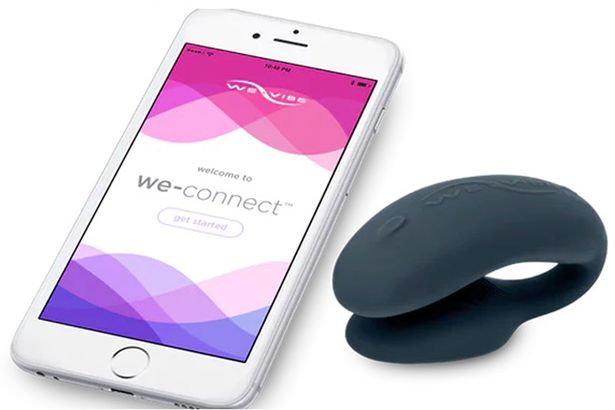
Dr. Devlin cited the case of Standard Innovation, a US-based tech company that makes internet-connected sex toys under the We-Vibe branding, which is currently being sued.
The company is being accused of recording incredibly personal data – including things like vaginal temperature and preferred intensity setting – without the user’s consent.
The woman’s lawyer, Eve-Lynn Rapp, said: “This is one of the more incredible invasions of privacy we’ve ever dealt with.”
Teh We-Vibe sex toy(Photo: WeVibe)
“We do collect certain limited data to help us improve our products and for diagnostic purposes,” Standard Innovation said in a .
“As a matter of practice, we use this data in an aggregate, non-identifiable form.”
Dr Devlin said that, in some cases, collecting personal data can be useful.
“For example, if it is fed back into the product to make it better,” she says, highlighting a thermometer gadget called Daysy that offers menstrual cycle tracking.
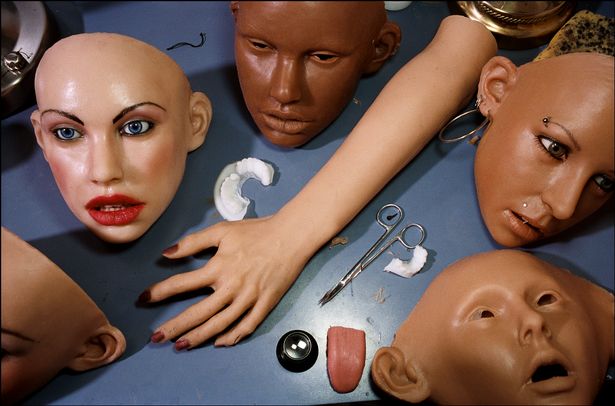
Various components of the sex dolls(Photo: Getty)
User feedback has also been proven to improve the product’s accuracy.
“But do we want people to know when we have sex and how we have sex?” she asked.
The argument is that if data collection is not monitored it could very easily turn into a slippery slope of personal data collection which is then open to hackers.
Despite raising concerns about both the data collection and the objectification of women that are by-products of sex robots, Dr Devlin argues that they are a positive development.
Jude Law, as male sex robot Gigolo Joe in AI, was programmed to have sex with women(Photo: Warner Bros. Pictures)
“There are a lot of heath benefits. You can be attached to something that’s not human and we’re already providing a lot of health and therapeutic technology to help older people in care homes. Why can we not provide sex tech as well?”
“The other thing that concerns me is the sexism. Women are massively underrepresented in the technology world and we see that reflected in the products.”
Back in 2007, artificial intelligence researcher David Levy from the University of Maastricht told LiveScience that people could be marrying robots – and consummating their vows – by 2050.
Although it might not appeal at first, he said, “once you have a story like ‘I had sex with a robot, and it was great!’ appear someplace like Cosmo magazine, I’d expect many people to jump on the bandwagon.”
In his PhD thesis, “Intimate Relationships with Artificial Partners”, Levy stated that the more human-like robots become in terms of personality, function and appearance, the more likely they are to form romantic partners for real people.
“It may sound a little weird, but it isn’t,” he said.
The Love and Sex with Robots congress is running at Goldsmiths, University of London from December 19-20.
Long-distance relationships can be difficult and, while apps like FaceTime, Snapchat and Skype mean lovers can see and talk to each other – what about real physical intimacy? Enter: the Kissenger.
A gadget that enables couples to kiss each other through the internet, the Kissenger – derived from the words kiss and messenger – has been the subject of university lab tests for the last couple of years.
So how does it work?
Essentially, it’s a brightly-coloured holster that attaches to your smartphone with an inviting plastic pad attached at the bottom.
When you lock lips with it, the pad senses pressure points and transmits the sensation through to an identical holster on your partner’s phone, wherever they may be.
“Kissing is the most direct and universal expression of intimacy and affection,” Emma Yann Zhang, who worked on the prototype, told an audience at the Love and Sex with Robots congress at Goldsmiths, University of London.
“It’s a way for us to bond and maintain intimacy in our relationships.”
The creators of the device say it has also helped users get on-board with machine-based touching and while it is aimed at couples, it can be used outside of romantic relationships. “Parents can also use Kissenger to give their children a kiss on the cheek when they are away at work,” its creators said.
While they admit that a lot more work is needed to create a more lifelike make out experience the next stages of development are already underway.
Subsequently, the team are now looking to build scent into the Kissenger, so the user can get the authentic smell of the person that they want to kiss.
While many people are of the opinion that sex robots are for the lonesome, a new survey suggests otherwise.
The survey revealed that almost half of the male population, single or in a relationship, could buy a sex robot within the next five years.
At the University of Duisburg-Essen in Germany, Jessica Szczuka, co-authored a study which focused on what is likely to influence men as to whether or not to buy a sex robot.
A whopping 40.3 percent of the 263 straight males that were surveyed for Ms. Szczuka’s research said that they could imagine using a sex robot within the next five years.
According to Szczuka, the responses didn’t vary between those that were single and those in relationships.
She also suggested that the number may be higher in the real world as participants may have lied in the survey.
Speaking at the Love and Sex With Robots congress at Goldsmiths University in London, she said, “If people have the guts to say ‘yeah I could imagine that’, that’s a good sign”.
She also believes that as people grow familiar to the robots, the number “will double over time”.
While just under half of men could imagine buying a sex robot within five years, more than two-thirds of males could imagine using them.
Although, the most likely people to use one will be socially anxious people.
“Someone with a fear of rejection could control the robot because the robot would never reject them.”
Machines that are built like women for sexual purposes are becoming more and more popular. In countries like Japan, it has already caused a decrease in traditional sexual encounters between human beings.
In countries like Japan, it has already caused a decrease in traditional sexual encounters between human beings.
Awesome. I hope so. I hope more people dump their seed all over movie theater chairs or in robots. The planet is overpopulated enough.
Spanish researchers are currently developing virtual reality porn theaters where the audience will be able to take part in virtual orgies with the actors. Via touch screen, 3D glasses, surround sound, and vibrating seats, up to twelve people at a time will be able to engage in virtual gangbangs with stars. In the future, this may even involve sex robots to make the shows interactive.
The Daily Mail reports that Christina Portales of the University of Valencia told experts at a recent Love and Sex with Robots conference (yeah, that’s totally real) in London:
All senses have been integrated. People will see, people will smell, people will touch. They will feel the movement. It is not an individual activity. It is a group.
Inventors say this will be more addictive than porn. I’ll bet you ten dollars it makes sex obsolete.
I was going to start this article about robots with a not-so-clever reference to Fritz Lang’s Metropolis. But then I spoke to Blay Whitby, a philosopher concerned with the social impact of emerging technologies and the trivialisation of robots in the media – and I decided otherwise.
Because when it comes to robots, it’s simply no use discussing them through the lens of our favourite film or science fiction book. Cliched as it may be, the future is here; we can and should talk about reality. Within a matter of decades we’ve become entirely reliant on technology and robots are increasingly part of our everyday lives.
The latest chapter comes courtesy of Dr Trudy Barber, a pioneer in the impact of technology on sexual intercourse. Speaking at the International Congress of Love and Sex with Robotics, Dr Barber said people’s growing immersion in technology means it’s only a matter of time before it takes a mainstream role in sex.
Put simply: sex between couples will increasingly be saved for special occasions as robots step in to satisfy our everyday needs. Dr Barber predicted the use of artificial intelligence (AI) devices in the bedroom will be socially normal within 25 years and that the machines would enable people to appreciate ‘the real thing’.
“I think what will happen is that they will make real-time relationships more valuable and exciting”, she added.
Devices such as Rocky or Roxxxy True Companion can currently be bought for around £7,000, but advances in the field are predicted to make sex robots increasingly lifelike and affordable.
Indeed, in April this year, a man figured out a way to make a robot in his own home that resembled a woman they don’t know.
Ricky Ma, 42, a Hong Kong-based man with no formal training in robots, spent £35,000 to create a robotic woman who looks exactly like Scarlett Johannson. And there’s absolutely nothing she can do about it.
Unlike the vivacious and intelligent actress, his robotic counterpart was programmed to respond to questions like ‘you are very beautiful’ and ‘you’re so cute’ with little more than a coquettish smile and a wink.
It’s an utterly disappointing reflection of the way women are portrayed in society – Ma’s clever three dimensional creation is about as one dimensional as you can get.
The ‘Mark 1’ robot that looks like Scarlett JohanssonCREDIT: BOBBY YIP / REUTERS
Is all this cause for concern? Of course. Because right now more money is being spent on making these things than thinking about the ethical and societal ramifications. We already know porn provides a terrifying reflection on how society views women, which can manifest itself in real life.
But what happens when machines start contributing to the objectification of women too?
There’s also a real worry that people will abuse robots assigned human traits – whether it be in a sexual or physical way. Whitby thinks it’s a legitimate concern: “Will people mistreat robots? Oh yes, I’m sure. The reason I’m sure is because they already do. The way people first meet artificial intelligence is in a character in a video game that they’re shooting at.”
As we are yet to truly understand the effect that playing violent video games has on young minds, it will be years before we even begin to comprehend the knock-on effects that the mistreatment of human-like robots has on our behaviour towards each other.
Dr Kathleen Richardson, a Senior Research Fellow in the Ethics of Robotics at the Centre for Computing and Social Responsibility, has done extensive research into this area – especially in regards to women. She says: “A machine, like the portrayal of women in pornography, prostitution and the media are entirely objects for male gratification. But women aren’t like what males see in pornography or in prostitution or in popular media.
“In these areas women are coerced or told how to be have act or behave with a threat of money or violence. In real life, women really have their own thoughts and feelings and preferences and desires. It seems logical that if this extreme control can’t be experienced by men with real women, the only next step is to create artificial objects.”
The people creating these robots are also partly to blame. A 2014 Nesta study titled ‘Our Work Here Is Done: Visions of a Robot Economy’ examined how gender is assigned to machines in the workplace. Researchers found that ‘male’ robots are thought to be better at repairing technical devices while ‘female’ robots are thought to be more suited to domestic and caring services.
In other words: people with gendered ideas make robots that conform to gender norms, which then perpetuates existing stereotypes.
As long as these norms go unchallenged, and robots are designed to fulfil perceived gender roles (has anyone yet talked about a male ‘sex robot’?) this vicious cycle will continue.
But it doesn’t have to be this way. What if the people programming and designing these robots didn’t have such stereotypical views? What if they used this amazing new platform to defy gender stereotypes, and rather than serving as a poor reflection on society, instead inspired us to look at ourselves in new ways?
It’s a nice thought. But as long as manufacturers stand to make a profit from robotics, and see these types of characterisations as a means to creating more humanised, relatable machines that sell better, not much is going to change.
Inventor Douglas Hines with his True Companion sex robot, RoxxyCREDIT: ROBYN BECK
At the 2016 AAAS (American Association for the Advancement of Science – the world’s largest scientific society) annual meeting, Yale ethicist Wendell Wallach spoke of his concerns about AI. He said: “There’s a need for more concerted action to keep technology a good servant – and not let it become a dangerous monster.”
While codes exist to guide the creation of machines, the lack of law in place means that time and effort is being ploughed into manufacturing and programming, and no one is thinking twice about the effects this will have on living and breathing humans. Being cautious isn’t sexy in the business of technology – and it rarely comes with financial rewards.
Whitby urged us to act now, before it’s too late. “We need to have these discussions instead of waking up one day when robot companions are normal and question whether it was a good idea or not,” he says.
And as this kind of technology is rolled out around the world, he had a stark warning about where the democratisation of technology is taking us: “How would you feel about your ex boyfriend getting a robot that looked exactly like you, just in order to beat it up every night?”
It’s a shocking idea, isn’t it? On the one hand, it’s a machine – it isn’t you. But then, it is you, because it stands for you, and who you are.
Whitby added: “I mean, it might be alright, it might mean he can be calmer and more normal with you – think about Aristotle’s theory of catharsis. But we really haven’t discussed this as a society. We’re drifting towards it and the technology is very close to being available, but we just aren’t talking about it.”
It’s time we started having these conversations, before those oft quoted science fiction dystopias become a nightmarish reality.
Use of artificial intelligence (AI) devices in the bedroom will be socially normal within 25 years, an international robotics conference has heard.
Comparing sex robots to the rise of the ebook, Dr Trudy Barber, a pioneer in the impact of technology on sexual intercourse, said the machines would enable people to greater appreciate “the real thing”.
Devices such as Rocky or Roxxxy True Companion can currently be bought for around £7,000, but advances in the field are predicted to make sex robots increasingly lifelike and affordable.
Speaking yesterday at the International Congress of Love and Sex with Robotics, Dr Barber said people’s growing immersion in technology means it was only a matter of time before it takes a mainstream role in sex.
“It could be that we are so busy with our lives, we are so embedded in our technological narrative that the idea of engaging in long-distance sex and robot sex is actually a natural process in our evolutionary cycle,” she said.
“I think what will happen is that they will make real-time relationships more valuable and exciting.”
However, AI experts have been warning that a generation of adolescents risk “losing their virginity” to humanoid devices and growing up with an unrealistic conception of sex.
In June leading scientist Dr Noel Sharkey, a former advisor to the UN, called on governments to prevent robotics being hijacked by the sex industry.
“I think what will happen is that they will make real-time relationships more valuable and exciting” – Dr Trudy Barber
Inventor Douglas Hines with his True Companion sex robotCREDIT: ROBYN BECK
But Dr Barber said the robots would effectively become an “extra human race”.
“The question is not “when will it become acceptable” but “when will we integrate”.”
“We are able to have so many colours on our sexual pallet now; I think we’d be daft not explore them.”
Questions that will face regulators involve how much data to allow robots to collect about their human partners and send back to their manufacturers.
Others include whether to legislate for purely passive robots, or to allow devices which entice humans to have sex, and whether robots would have to make clear that they are machines rather than humans.
Kate Devlin, computing expert at Goldsmiths, University of London, said it was probable future sex robots would be designed to learn their human partner’s sexual preferences to improve performance.
“Companion” devices such as the Pepper robot are being increasingly used to provide stimulation to elderly people, particularly in Asian countries such as Japan.
Created two years ago, the humanoid robot is designed with the ability to read certain emotions from analysing expressions and voice tones.
Scientists have said there is evidence the devices are being used by parents to keep their children company.
Professor Sharkey yesterday challenged the prediction that sex robots would become mainstream.
“Sex robots will be used within the next decade but it is doubtful if they will become a societal norm although surveys show that around 10% would be prepared to use them.
“They are more likely to be viewed as tools for masturbation although having a humanoid body may make a difference to the fantasy.
“Would you leave your sex robot out if your mum came to visit?
“Prostitution has been around for thousands of years and yet has never been socially normalised.
“The problem is the same for both.
“With sex robots and prostitution, you are having a one way relationship with an object or a person that does not return your love except by pretence.”